Street Plays – Childhood in Kreuzberg
“I can remember scenes from my childhood, when these streets were still right at the Berlin Wall and it was rare for children’s street plays to be interrupted by cars.”
— Kaya Behkalam
Since the 1970s, the everyday presence of migrant children on the streets of Kreuzberg shaped how artists perceived the district. The children’s living conditions but also their hopes and dreams became central themes in numerous works from this period.
Ararat Verlag
Ahmet Doğan founded Ararat Verlag in Stuttgart in 1977. Two years later, he established his publishing offices in Kreuzberg. Until the mid-1990s, the company published German translations of literature written in Turkish, including works by Vasıf Öngören (1938–1984) and Aras Ören (*1939). He collaborated closely with artists such as Hanefi Yeter, Serpil Yeter and Akbar Behkalam, who regularly designed book covers and illustrations. Among his other projects was a German-Turkish series of school textbooks, which emerged as part of new educational policies for Turkish language instruction in West Berlin. The series included a wide variety of texts on migration, literature and everyday experiences, as well as illustrations by artists. Although the project was considered innovative in West Berlin, it was sharply criticised by the Turkish government, particularly due to the inclusion of poems by the communist-influenced poet Nâzım Hikmet (1902–1963), who had long been banned in Turkey.

Kreuzberg: Kunst und Migration seit 1960, installation view, Gropius Bau, 2026
© Gropius Bau, photo: Rosa Merk
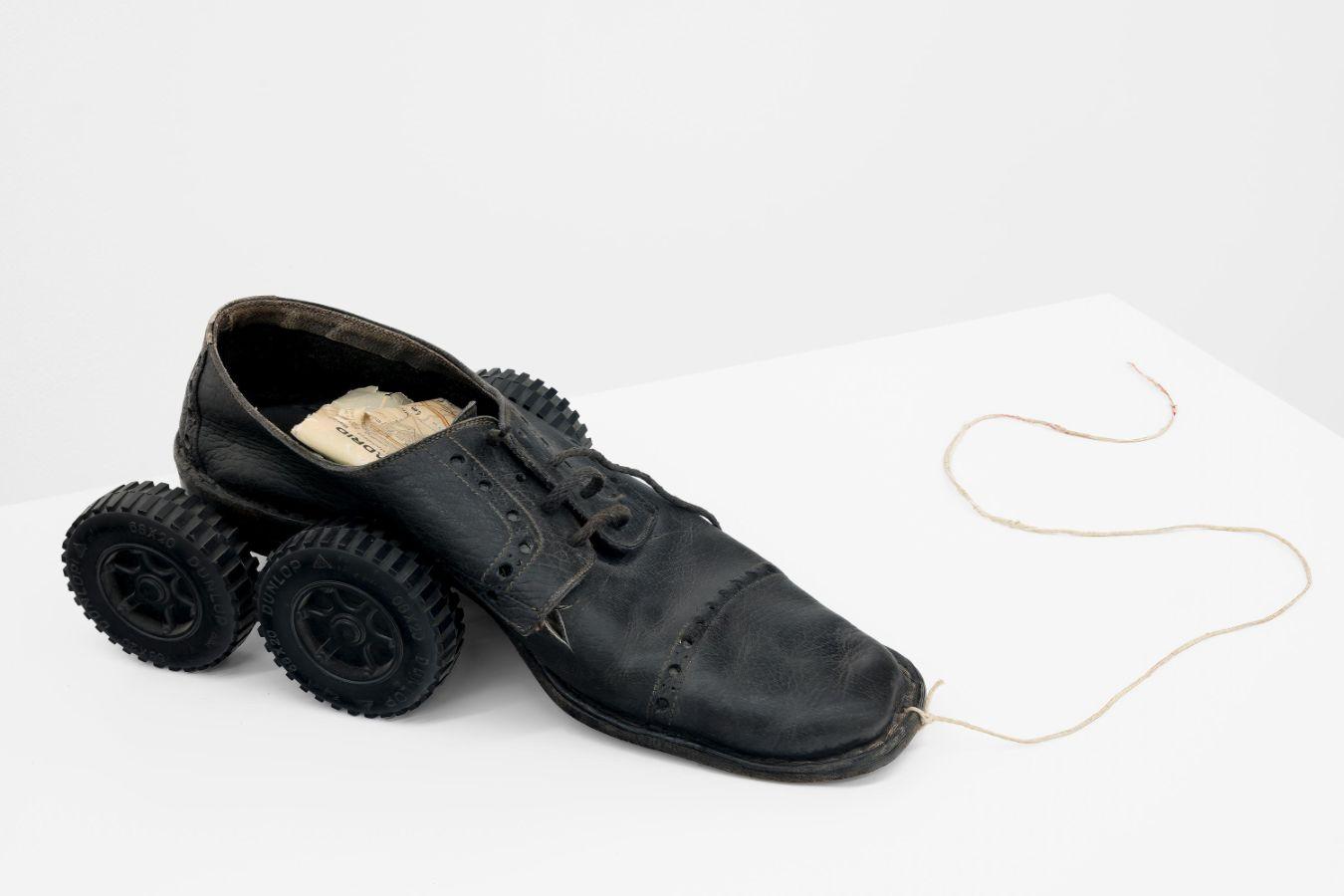
Vlassis Caniaris
Untitled
(1974)
During his time in Berlin in the early 1970s, Vlassis Caniaris explored the living and working conditions of migrant workers. In his artistic research, he focused on the precarious housing situation of migrant families, among other things. He visited their homes, documenting them in part through photography, and used this research as a starting point for his artistic installations. However, Caniaris’ work extends beyond describing the difficult living conditions of migrant families in West Berlin: He combines everyday objects to create a children’s room that opens up poetic visual worlds and shows how a child’s imagination can turn the simplest materials into a home.

Kreuzberg: Kunst und Migration seit 1960, installation view, Gropius Bau, 2026
© Gropius Bau, photo: Rosa Merk

More on Vlassis Caniaris

Esther Friedman
Kreuzberg
As the daughter of Holocaust survivors who had emigrated, Esther Friedman moved from New York to West Berlin in 1974, where she worked as a fashion photographer. Her images from the late 1970s depict the divided city as a cosmopolitan hub and a subcultural playground for artists, musicians and fashion designers. The three photographs on display were taken during her numerous walks through Kreuzberg, a neighbourhood where migrant workers lived alongside international artists. Kreuzberg captures the encounter between different social realities at the margins: while a group of girls passing by perform for the camera in the foreground, the US-American musician Iggy Pop, the artist’s partner at the time, appears in the background as a detached observer. Friedman’s photographs also seem to open up space for the children of migrant workers, who pose for the camera with playfulness and confidence.

Esther Friedman, Kreuzberg, 1978/2026
© VG Bild-Kunst, Bonn 2026
Mehrangis Montazami-Dabui
Analphabeten in zwei Sprachen
(1975)
Mehrangis Montazami-Dabui moved to West-Berlin in 1969. She studied film at the Deutsche Film- und Fernsehakademie from 1972 onward. During this period, she created the documentary Analphabeten in zwei Sprachen, which examines the situation of children of so-called guest workers from Turkey in Kreuzberg schools. The film interweaves footage of the district’s neglected urban landscape, statistical data and educational events with personal accounts from teachers, migrant students and parents. These testimonies not only describe feelings of overload, anxiety and hopelessness but also reveal a school system characterised by overcrowded and often segregated classes. Children from Turkey were frequently taught in “Ausländerregelklassen” (foreigner classes), separated from their peers whose first language was German. This isolation hindered language acquisition and systematically limited the educational opportunities of migrant students. Thus, the film challenged the widespread racist discourse, which attributed early school dropouts and high unemployment among migrant youth to personal failure.

Mehrangis Montazami-Dabui, Analphabeten in zwei Sprachen, 1975, courtesy: Film Distribution of Deutschen Kinemathek – Museum für Film und Fernsehen
© Mehrangis Montazami-Dabui

Mehrangis Montazami-Dabui, Analphabeten in zwei Sprachen, 1975, courtesy: Film Distribution of Deutschen Kinemathek – Museum für Film und Fernsehen
© Mehrangis Montazami-Dabui

Mehrangis Montazami-Dabui, Analphabeten in zwei Sprachen, 1975, courtesy: Film Distribution of Deutschen Kinemathek – Museum für Film und Fernsehen
© Mehrangis Montazami-Dabui
Pınar Öğrenci
Gurbet artık bir ev / Gurbet is a home now
(2021)
Gurbet artık bir ev / Gurbet is a home now by Pınar Öğrenci critically examines the urban policy measures of 1970s and 1980s West Berlin that regulated the influx of migrants into neighbourhoods such as Kreuzberg. Drawing on Esra Akcan’s book Open Architecture (2018) and the photographic archive of architect Heide Moldenhauer, the film revisits the history of migrant communities from Turkey. Through interviews with people who appear in Moldenhauer’s photographs, the archival images are connected to lived experience. In her first artistic work since moving to Berlin in 2018, Öğrenci adopts an intergenerational feminist perspective to challenge stereotypical representations of female migrants and Kreuzberg as a site of marginality and otherness. The film foregrounds everyday practices of care, solidarity and self-organisation, revealing how gurbet – a condition of displacement – became a place of belonging through collective homemaking.

Pınar Öğrenci, Gurbet is a home now, 2021, film still
© Pınar Öğrenci, photo: Heide Moldenhauer
Caroline Pinger
Sanierungsspielplatz
(1974)
After studying in Salt Lake City and New York, Caroline Pinger moved to West-Berlin in 1962. She ran her own printmaking workshop starting in 1967, with brief interruptions. Throughout the 1970s and 1980s, she captured the divided, bombed-out city in prints, collages and drawings. Her detailed woodcut compositions depict people in various settings, including on streets, at construction sites, on playgrounds, at train stations, during demonstrations and in nightclubs. Sanierungsspielplatz portrays a bustling scene of children and adolescents. The title highlights the absence of designated play areas, compelling children to play in the streets or in abandoned structures awaiting renovation. The print also speaks to the presence of socio-political issues in public spaces. As the slogan “Tod dem Faschismus” (Death to Fascism) on a building wall in the background shows, these issues have frequently been addressed in Kreuzberg through murals and graffiti since the 1970s.

Kreuzberg: Kunst und Migration seit 1960, installation view, Gropius Bau, 2026
© Gropius Bau, photo: Rosa Merk
Monika Sieveking
Spielplatz in Kreuzberg
(1974)
Monika Sieveking frequently spent time in Kreuzberg, translating her observations into paintings that critically address social issues. At the centre of Spielplatz in Kreuzberg is a sign explaining the playground rules in German, Turkish and Serbo-Croatian. Though the sign refers to a playground, there are no play structures visible in the background. Instead, the image shows the elevated subway tracks typical of Kreuzberg and a street intersection. In the foreground, two children who appear to be of a migrant background are huddled together and facing the viewer directly. The image highlights the lack of child-friendly public spaces.
More on Monika Sieveking
Hanefi Yeter
Analphabeten in zwei Sprachen
(1978)
In Analphabeten in zwei Sprachen, two schoolchildren stand before a chalkboard displaying language lessons in German and Turkish. In the 1970s, Kreuzberg lacked school curricula and bilingual teachers to introduce migrant children to the German language. Due to the precarious financial situation of families brought to Germany under labour recruitment agreements, parents often worked long hours and could spend only limited time with their children. As a result, opportunities for the children to further develop their first-language skills were limited. To counteract this, Ahmet Doğan began publishing the book series Texte in zwei Sprachen (Texts in Two Languages) in the late 1970s through his publishing house, Ararat, which included German translations of stories written in Turkish. Illustrated by Yeter, these German-Turkish books aimed to promote children’s multilingualism.

Hanefi Yeter, Analphabeten in zwei Sprachen, 1978, courtesy: Kunstraum Kreuzberg/Bethanien
© Hanefi Yeter