Treffen junge Szene
Dance
Till Eulenspiegel – Teile Von Mir
theater für niedersachsen, tfn-Jugendensemble in Kooperation mit SALTAZIO, Schule der Tanzkünste
Hildesheim, Lower Saxony
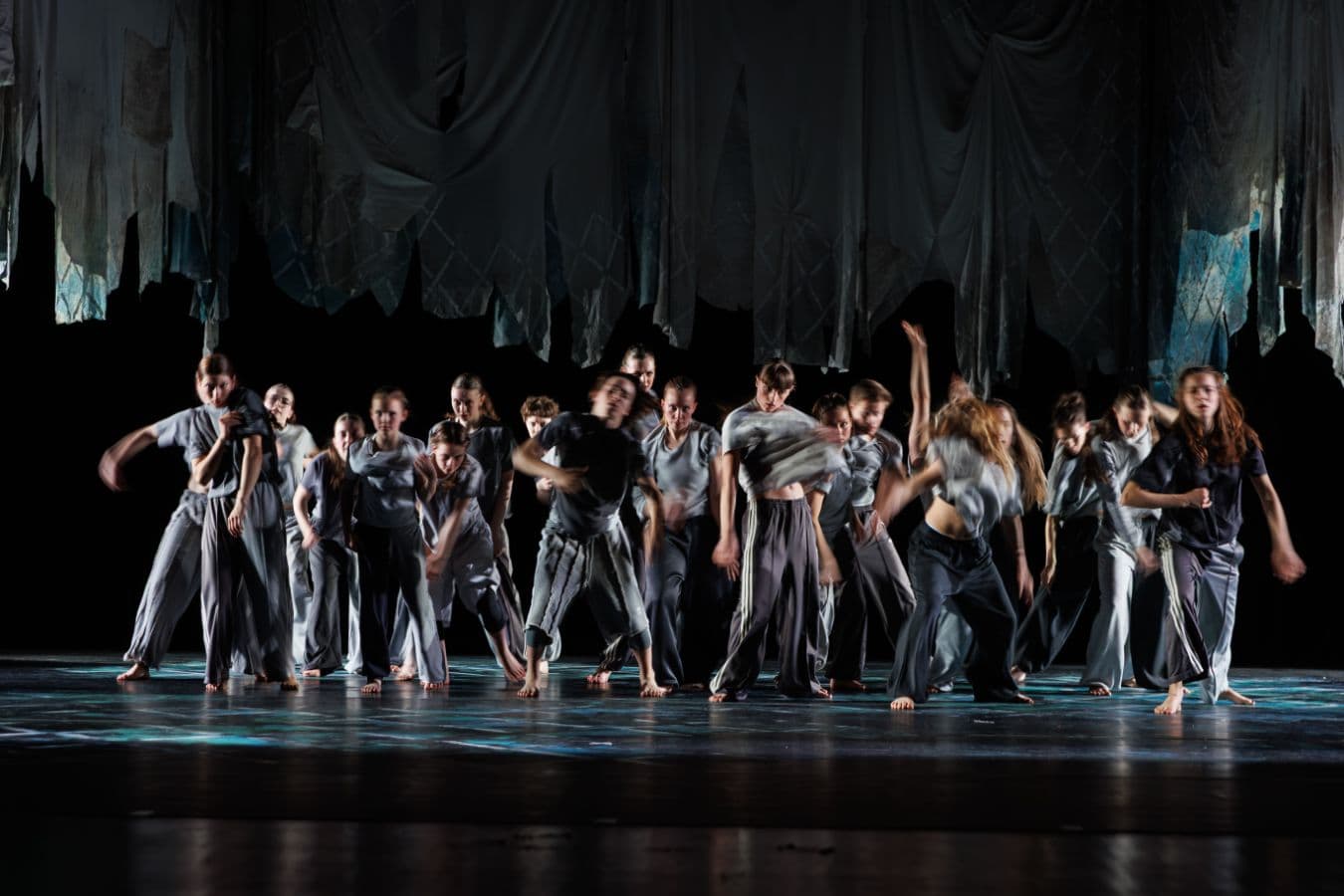
Till Eulenspiegel – Teile Von Mir © Tim Müller, buehnenfotograf.de
The ensemble approaches the figure of Till Eulenspiegel as a symbol of contradiction, curiosity, and defiance. Blending contemporary dance and performance, the piece creates striking images that explore what Eulenspiegel might represent today. It plays with expectations and invites audiences to reconsider rules and conventions through Till’s eyes.
Production and Ensemble
In Till Eulenspiegel – Teile Von Mir, the ensemble explores the figure and legacy of Till Eulenspiegel. Like Eulenspiegel himself, the production resists straightforward categorisation: contemporary dance meets performative elements, while choreographic and theatrical approaches intertwine to open up multiple perspectives on the material.
Defiance is the starting point. Eulenspiegel refuses to be the person others expect or want him to be. The ensemble embraces this attitude, taking expectations as its point of departure before subverting, disrupting, or playfully affirming them. In doing so, Eulenspiegel becomes not only a character but also an artistic practice of questioning established norms.
At the heart of the work lies the question of what a Till Eulenspiegel might be today—and whether we ourselves can be Eulenspiegel. Alongside references to well-known episodes, including the famous tightrope walk, the recurring question, “Am I Till?”, runs throughout the piece. Choreographic scenes connect this search with the lived experiences of the ensemble members, revealing the many different ways Eulenspiegel can be imagined and embodied.
Embedded within the story of Till Eulenspiegel is a broader exploration of the individual’s place within society and of our capacity to transform it. The production invites audiences to view rules, conventions, and certainties through Eulenspiegel’s eyes, asking: “Does this really make sense? Could it be done differently? Does it have to be this way?”
Jury Statement by Jan Kress and Sonia Franken
Young people from Hildesheim hold up a mirror to us—or rather, true to the title of their piece, an Eulenspiegel. They do so through contemporary dance that confidently and inquisitively engages with a story that appears old and familiar: the tale of Till Eulenspiegel, whose exploits have been told since the sixteenth century and have long been part of the popular imagination. It feels as though all ninety-six surviving tales are danced into the present, filling the stage with a vibrant, ever-changing landscape. The performance continuously reshapes the space through clear entrances and exits, a deliberate interplay between ensemble and solo moments, and a careful balance of density and openness.
One of the tasks during the rehearsal process was: “How do you destroy a space?” followed by: “Now do it as a jazz version.” This seemingly paradoxical exercise encapsulates the production’s distinctive approach to the deliberately elusive figure of Till Eulenspiegel and its translation into the present day. The dancers ask not only, “Who is Till?” but also, “Where is Till within me?” Here, Till is not simply the prankster, the provocateur or the boundary-crosser, but also the voice that doubts, resists and feels overwhelmed. The Hildesheim Till appears only briefly as the familiar jester in a fool’s cap; instead, he becomes an artistic device through which the performers negotiate and embody questions of norms, social roles, tolerance, pressure and their own contradictions.
The piece is, quite literally, a sequence of numbered scenes—yet at the same time it resists that very idea. One scene follows another in rapid succession: small experiments, miniatures and sketches that are by turns uncompromisingly direct, tentative and poetic. Without hesitation, the work shifts between genres and theatrical forms. Particularly striking is the way it uses humour, precision and courage to dismantle the ambiguities of contemporary life. At one point, the very notion of tolerance is dragged onto the stage and taken apart: what does it really mean to be tolerant? At what point does tolerance become indifference—or even self-sacrifice?
During the post-show discussion, one remark captured the essence of the work: “Through Till, we got to know ourselves and each other.” This production draws on a classic source to explore perceptions of self and others, creating a shared space for reflection in which young people can experiment, disagree, fail, laugh—and, throughout it all, take themselves seriously.
As a jury, we hope to see more works like this: productions whose ideas extend beyond the theatre and resonate in everyday life—in school corridors, playgrounds, families and circles of friends. At the same time, we hope theatres and ensembles will build on these impulses to reach an even wider range of young people and encourage voices that have too rarely been heard on stage.
With and by
Thea Bartlakowski, Mina Burkhard, Kilian Dedroogh, Danica Dobric, Lydia Dorndorf, Greta Engelbrecher, Leonie Francke, Hanna Gärtner, Naemi Hauser, Pauline Hennies, Johanna Kunze, Delia Lenz, Emil Maasberg, Amy Mittelsteiner, Mina Riebau, Scarlett Rotmann, Ani Safarian, Ava Tavares, Dune Tavares, Lilith Tavares
Felix Berner, Judith Hölscher – directors, choreography
Lars Linnhoff – stage design
Amelie Müller – costumes
David Pagan – composition
Philipp Wegerer – dramaturgy
Benjamin Hanke – assistant director
Nadine Dannemann – assistant stage design
Jil-Joséfin von der Oelsnitz – assistant costume design
Mick Lee Kuzia – stage manager
Maite Herborn, Cosmo Aurelio Kühnert – trainee choreography