Concert
Ensemble Dedalus III
Pascale Criton / Peter Ablinger
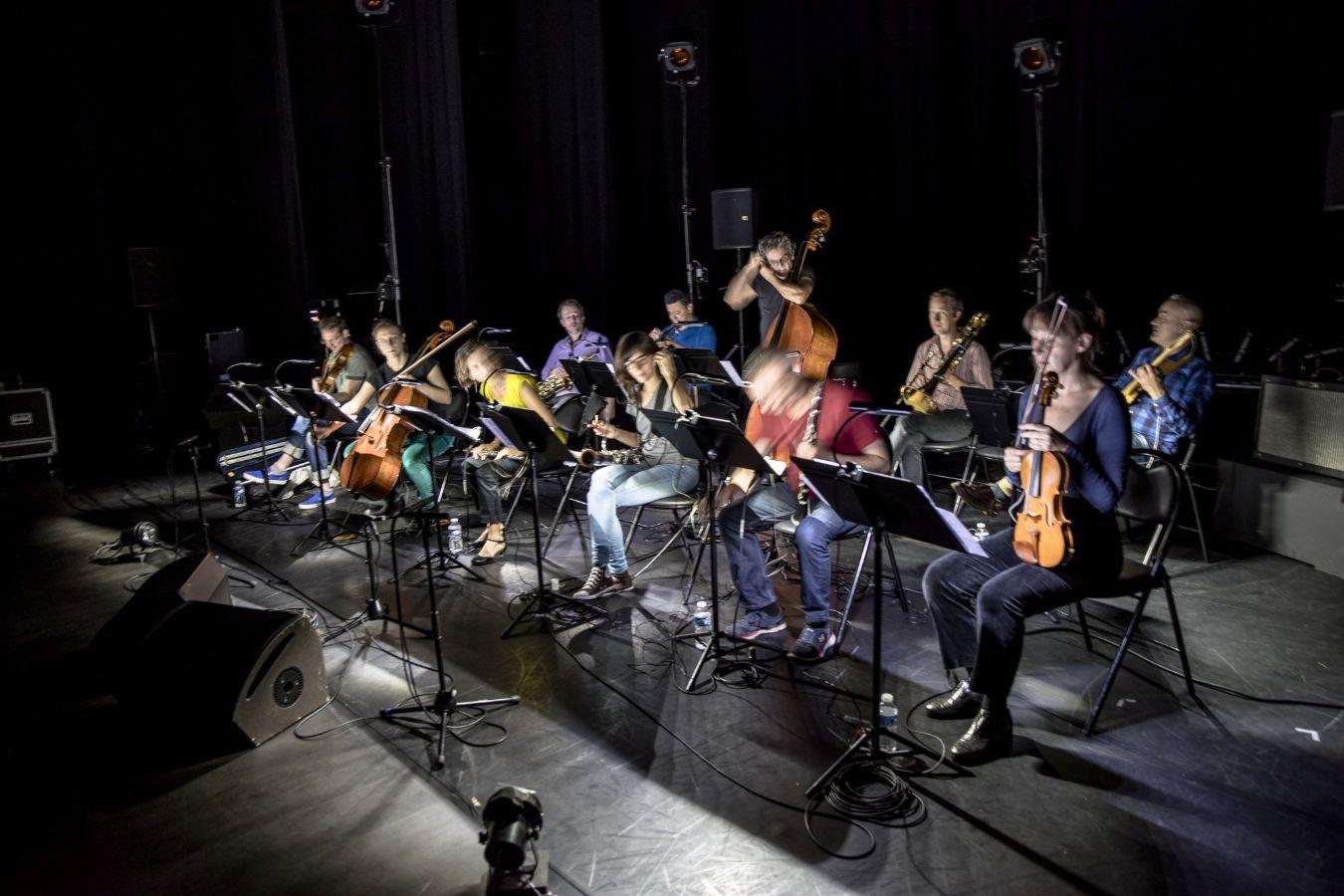
Ensemble Dedalus © Christophe Chaverou
“Every situation is a study, an experiment that develops its own means. Experiment – never interpret!” This statement by sound philosopher Pascale Criton perfectly characterises the working practices of the long-standing companions of Ensemble Dedalus, being presented in various portrait concerts as part of MaerzMusik 2026. With the composer Peter Ablinger, who died in 2025, the ensemble honours a radical thinker and sceptic of sound. His works, that deal with the phenomenon of interruption, are juxtaposed with current compositions by Criton, which explore the materiality of sound.
Peter Ablinger’s subtle open scores, often based on concise instructions and detailed drawings, characterise both his work Instruments & (sketchbook) and the WEISS / WEISSLICH series, which the Austrian composer and long-time Berlin resident developed over a period of 30 years. The Dedalus Ensemble presents several pieces from Instrument und Rauschen, in which individual instruments are contrasted with different qualities of noise, sound, and microtonal sound structures.
Since her childhood, Pascale Criton has been experimenting with finely tuned instruments, which she tunes down to one-sixteenth of a standard tone for her compositions. The Dedalus Ensemble is focusing on her latest compositions: Process for quintet plays with a balance of free-floating variables, tense at first and then slowly shifting into a descending movement. These mobile elements gradually stabilise into a regular beat pattern. Steppings is based on a constant percussive motif. On top of this, the microtonally tuned string instruments and multiphonically played wind instruments create subtle sonic variations at the borders between timbre, sound, and noise. Streams explores transformations of sound in interaction with the surrounding space. The five instruments play with tiny variations that encourage interference such as beats and other psychoacoustic phenomena.
As part of MaerzMusik, the Dedalus Ensemble is performing several portrait concerts offering insight into unique projects, all based on open scores. These projects and the exceptional musicians involved have enabled the ensemble to develop its own distinctive, dense sound. Defying traditional categories, the ensemble’s artistic practice follows elaborate concepts yet conveys a sensual experience that remains both radical and captivating, subtle and powerful.
Programme
Peter Ablinger
WEISS / WEISSLICH 17, Instrument und Rauschen (1994–2023)
17b: Violin and noise (1995)
17q: Bass trombone and noise (2017)
17d: Flute and noise (1996)
17o: Viola and pure tone (2016/17)
17f: Soprano saxophone and noise (1996)
17p: Trumpet and noise (2017)
Instruments & (sketchbook) (2015)
for ensemble and live-electronics
Pascale Criton
Process (2013)
for flute, trombone, violin, cello and guitar
Steppings (2013)
for flute, trombone, violin, cello and guitar
Streams (2025)
for flute, trombone, violin, cello and guitar
Commissioned by klub katarakt
Cast
Ensemble Dedalus
Didier Aschour – guitar
Amélie Berson – flute
Pierre-Stéphane Meugé – saxophone
Christian Pruvost – trumpet
Thierry Madiot – trombone
Silvia Tarozzi – violin
Cyprien Busolini – viola
Deborah Walker – cello
Dedalus is supported by DRAC Occitanie and Conseil Régional Occitanie. The ensemble has also received support from SACEM, SPEDIDAM, Maison de la Musique Contemporaine, Impuls Neue Musik and Occitanie en Scène.