
Performing Arts Season 2025/26: Opening with the boldly visual Gesamtkunstwerk “The Great Yes, The Great No” by William Kentridge
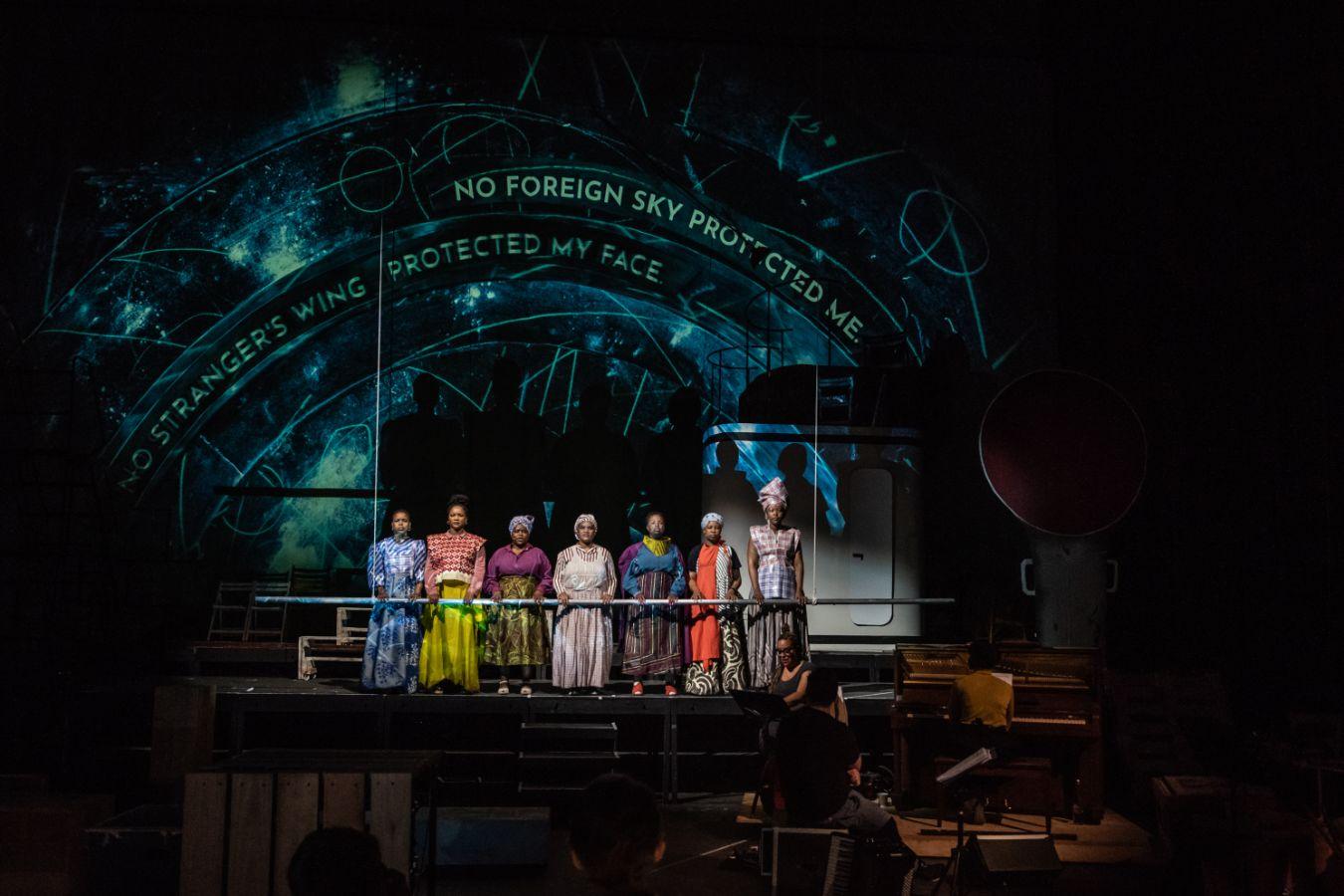
The Great Yes, The Great No
© Stella Olivier
The Performing Arts Season 2025/26 opens with three performances from 16 to 18 October of “The Great Yes, The Great No”, the latest music theatre production by the South African multi-disciplinary artist William Kentridge, on the Main Stage at the Haus der Berliner Festspiele. To accompany the performances, there will be a film screening on 18 October of his lecture “In Defence of Optimism | Slade Lecture No. 6”.
“The Great Yes, The Great No” is a theatre production, oratorio and a chamber opera all rolled into one and was devised in collaboration with the associate director, choral composer and dancer Nhlanhla Mahlangu, associate director Phala Ookeditse Phala and dramaturg Mwenya Kabwe. Based on real life events, the play presents a sea voyage from Marseille to Martinique in 1941. Using drawings, collages, film and masks as well as music, dance and theatre, a multi-layered narrative that combines both past and present unfolds around seeking refuge, exile, migration, colonialism and barbarism.
This blurs the boundaries between reality and fiction: on board the ship the “Capitaine Paul Lemerle”, attempting to flee the Vichy regime that collaborated with Hitler, historically documented travellers such as the novelist Anna Seghers, the Cuban painter Wifredo Lam, the writer Victor Serge and the anthropologist Claude Lévi-Strauss are joined by numerous other famous figures from both the past and future, including the psychiatrist and political theorist Frantz Fanon, the painter Frida Kahlo and the pioneers of the French Négritude movement Paulette and Jeanne Nardal, along with characters such as Trotsky and Stalin. Historical and literary epochs overlap as, for example, Josephine Baker dances with Joséphine Bonaparte. All travelers are united by the symbolic power and complexity of a sea crossing.
Captain Charon, the ferryman of the dead in Greek mythology, is the narrator who guides us through the plot, accompanied by an impressive, seven-member chorus. The numerous characters are presented through original portrait masks made of cardboard; projected film images of a miniature model ship convey the background to the action on stage. In eight different languages – English, French, isiSwati, isiZulu, isiXhosa, Setswana, Xitsonga and Sepedi – with surtitles in German and English, the ensemble carries the audience along on its very special journey into a new world.
In addition to the writings of the artists and thinkers mentioned above, fragments of which have found their way into the text, the libretto also contains short excerpts from the writings of Bertolt Brecht, Anna Akhmatova, Wislawa Szymborska, Marina Tsvetaeva and others. Kentridge’s visionary work straddles the boundaries of the visual and performing arts, while reflecting colonial history and affirming human rights.
WilliamKentridge, born in Johannesburg in 1955, is one of the most influential artists alive today. He works across the media of drawing, writing, film, performance, music, theatre and collaborative practices to create works of art that are grounded in politics, science, literature and history, always maintaining a space for contradiction and uncertainty. His work has been seen in museums and galleries around the world since the 1990s, including the Museum of Modern Art in New York, the Albertina Museum in Vienna, Musée du Louvre in Paris, the Reina Sofia Museum in Madrid and the Royal Academy of Arts in London. Both his visual art works and his large-scale opera productions are created in participatory processes and often have a historical or political background.
Kentridge’s most recent works to be presented by Berliner Festspiele were the exhibition “NO IT IS!” and the installation “More Sweetly Play the Dance” in 2016. In the same year, he also founded the Centre for the Less Good Idea in Johannesburg: a space for experimental, collaborative and cross-disciplinary arts practices. This is also where “The Great Yes, The Great No” was created, in an extensive process of workshops and rehearsals.
The German premiere of “The Great Yes, The Great No” in June this year at the Ruhrfestspiele Recklinghausen received a rapturous reception. To mark his 70th birthday, both the Museum Folkwang in Essen and the SKD (Staatliche Kunstsammlungen Dresden) are honouring William Kentridge with a major retrospective of his works.
Save the Date: Film Screening
In addition to the performances, on 18 October at 17:30 h, there will be a film screening at the Haus der Berliner Festspiele of the lecture by William Kentridge recorded at the University of Oxford in 2024 “In Defence of Optimism | Slade Lecture No. 6”. Admission is free of charge.
Accreditation for “The Great Yes, The Great No” will remain open until Thursday, 9 October. Press photos are available for download from the press section of the website.
A Look Ahead to the Performing Arts Season 2025/26
Under the artistic direction of Yusuke Hashimoto, between October 2025 and January 2026, the Berliner Festspiele’s programme series will present a further six international dance, theatre and performance productions that focus on how culture and identity are interrelated and demonstrate how powerfully the performing arts can articulate shared yet diverse experiences. You can see current works by the Akram Khan Company (“Thikra: Night of Remembering”), Eun-Me Ahn (“Post-Orientalist Express”), Gisèle Vienne and Étienne Bideau-Rey (“Showroomdummies #4”), Nina Laisné, François Chaignaud and Nadia Larcher (“Último helecho”), together with the world premieres of new creations by Thorsten Lensing (“Tanzende Idioten”) and Ligia Lewis (“Wayward Chant”). The full programme has already been published and tickets are available now from the Berliner Festspiele webshop.
Funding & Media Partners
The dance performances “Post-Orientalist Express”, “Showroomdummies #4” and “Último helecho” are presented with support from Dance Reflections by Van Cleef & Arpels. “Showroomdummies #4” is supported by the Agency for Cultural Affairs, Government of Japan, through the Japan Arts Council.
Media Partners: radio3 (vom rbb), ARTE, Dussmann das KultuKaufhaus, Monopol – Magazin für Kunst und Leben, Der Tagesspiegel, WALL und Yorck Kinogruppe.
Press Contact
Sara Franke & Anna Hinz
T +49 30 254 89 269 / 132
presse@berlinerfestspiele.de