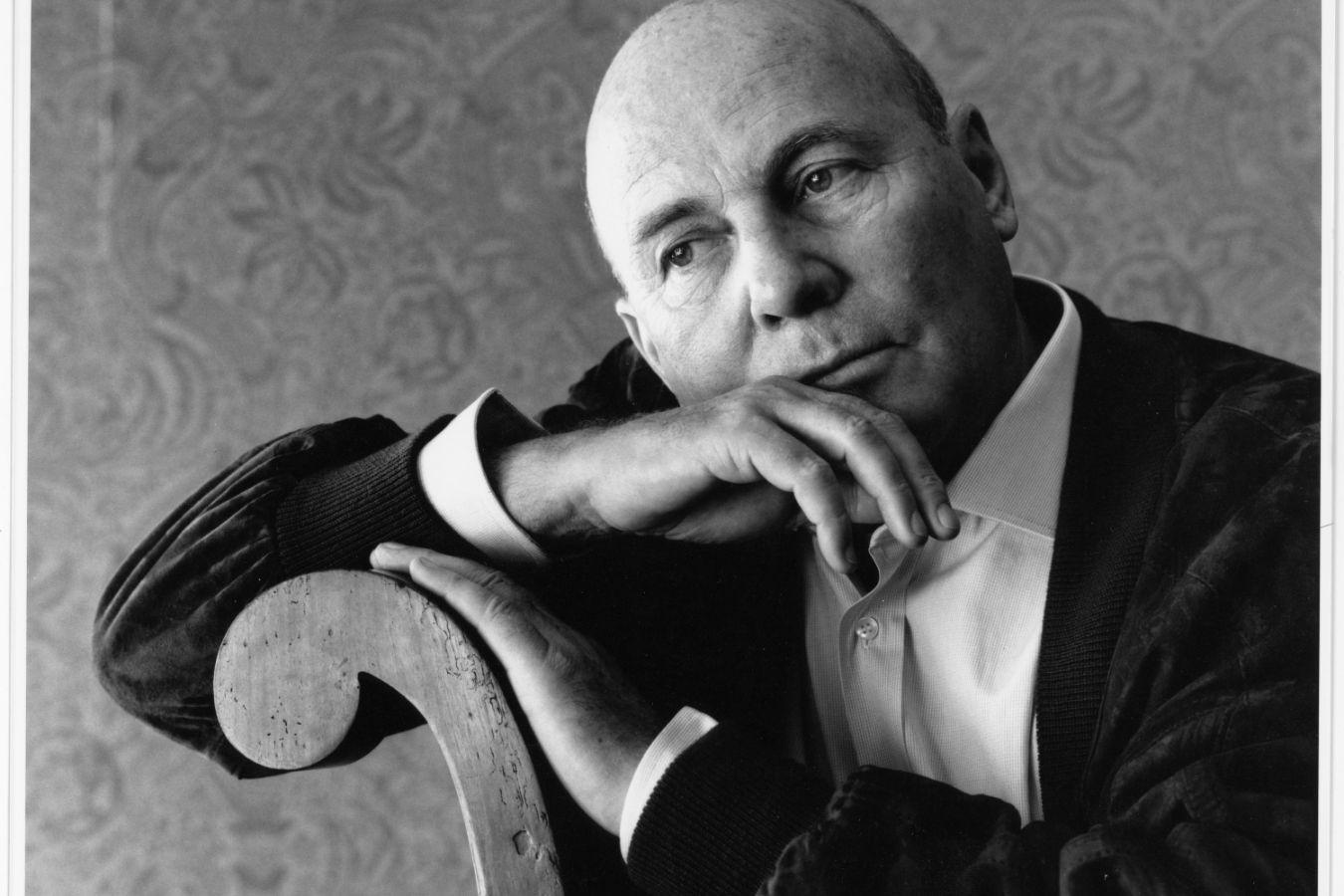
Hans Werner Henze © Malcolm Crowthers
Hans Werner Henze
Within the field of contemporary music, Hans Werner Henze (1926–2012) occupies a decidedly individual, solitary position. While many other composers seek to realise a particular musical concept as purely and consistently as possible, Henze is mainly concerned with making himself understood, reaching open-minded listeners and moving them without compromising his artistic standards. This approach coincides with his sense of drama as well as his great literary sensitivity. Dominated by operas and various stage works, Henze’s unusually rich oeuvre also includes ten symphonies and numerous other orchestral compositions, many of which are inspired by literature. Numerous pieces have the character of political engagement as well as protest in response to world affairs. Another constant feature of his work, quite independent of this, is his sense of beauty and aesthetic refinement.
Hans Werner Henze was born in Gütersloh into a family of music lovers. His youth was marked by fierce conflicts with his staunch Nazi father, conscription into labour service and the Wehrmacht at the age of 16, and the experience of the end of the war in British captivity. These experiences cemented Henze’s lifelong aversion to authoritarian tendencies and his position on the left of the political spectrum.
As a result of the war, Henze was only able to begin his musical studies later in his life. In 1946, he became a composition student of Wolfgang Fortner, then in 1949 of René Leibowitz, immersing himself in the realm of new music that had previously been suppressed in Germany. Henze’s works quickly established him as an independent voice among a young generation of composers, without ever belonging to the leading representatives of the Darmstadt avant-garde. In 1952, Henze met the poet Ingeborg Bachmann at a conference of the Group 47, a prominent post-war circle of authors, leading to a long and productive artistic friendship. In 1953, repelled by the stifling social climate in post-war Germany, Henze moved to Italy, which became his adopted home. For a time, he shared an apartment with Ingeborg Bachmann. Henze remained very present in German musical life, celebrating great successes and receiving prestigious composition commissions.
During the period of student unrest, Henze – now an internationally renowned artist – took a proactive stance on the side of the left, turning to explicitly political themes in his works. From the mid-1970s on, he was strongly committed to promoting young artists, launching music theatre festivals such as the Munich Biennale, and initiating projects for amateur musicians. Henze remained productive into his old age, creating several more music theatre pieces and large symphonic compositions. He died in Dresden on 27 October 2012.