Concert
RIAS Kammerchor Berlin I
Gregor Meyer, conductor
Henze / Brahms
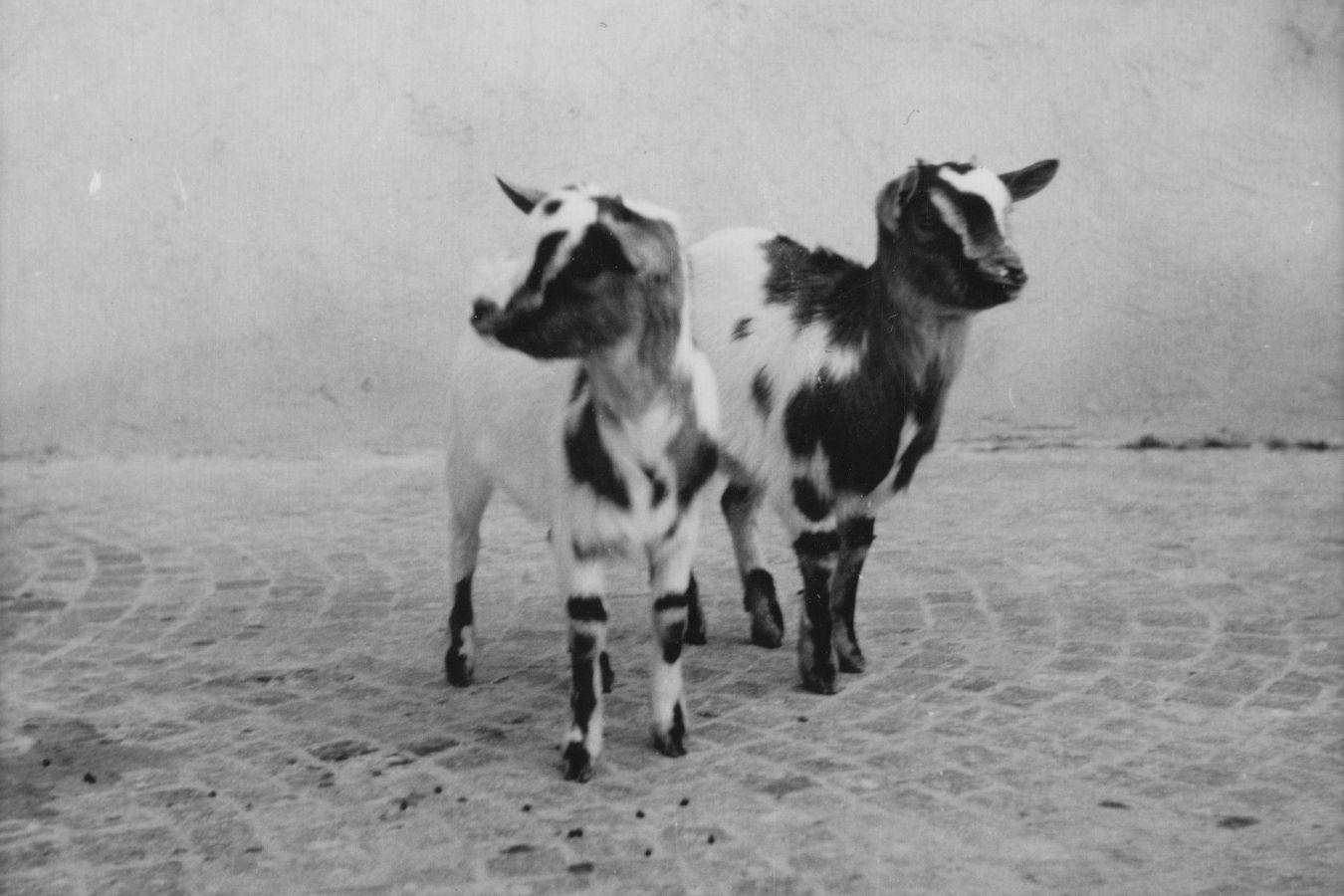
Goats in the courtyard of La Leprara, 1966 © Hans Werner Henze-Stiftung
According to Henze, his concerto Musen Siziliens, which premiered in 1966 as part of the Berliner Festwochen, was intended to “be fun” – both for the audience and the performers. Johannes Brahms must have been thinking on similar lines when experimenting with multiple permutations of “Viennese” three-four time in his Liebeslieder waltzes for voices and four-hand piano. The RIAS Kammerchor Berlin will perform both works at the Musikfest Berlin together with the piano duo GrauSchumacher who in the words of the Süddeutsche Zeitung have “perfected four-hand piano-playing”, accompanied by musicians of the Junge Deutsche Philharmonie conducted by Gregor Meyer. As an atmospheric opener, Henze’s otherworldly, mysterious Notturno sets the tone.
 Digital programme booklet from August
“Regrettably not composed by myself” was Johannes Brahms’s comment on the waltz An der schönen blauen Donau by Johann Strauß (son) which was originally composed as a choral work for the Vienna Männergesangsverein [male-voice choir]. The Hamburg composer described by Eduard Hanslick as “serious and taciturn” took inspiration from his new adopted home of Vienna, especially during his early professional years, leading among other compositions to the Liebeslieder-Walzer op. 52, settings of poetry from Georg Friedrich Daumer’s collection Polydora. These sinuous settings ranging from capricious and coquettish or melancholic to intensely passionate enjoyed consummate success – not least because the individual movements effervesce with an inexhaustible abundance of catchy melodies despite being dictated by the rhythm of the waltz.
Not love, but rather inner contemplation in the face of the immeasurability of the cosmos lies at the center of Hans Werner Henze’s gently floating Notturno for wind instruments, double bass and piano: an instrumentally reimagined version of the conclusion of the second scene “Mond und Sterne” from his opera Die englische Katze. This is followed by Musen Siziliens leading into the idyllic pastoral world of Virgil’s Bucolica. In this unusually scored three-part work, Henze deliberately “veered away from the sound of a large orchestra and from polyphony and dodecaphony. […] In Musen Siziliens, my aim was to focus on highly simple formulations, circling around individual notes and rotating around tonal centres. It should be fun to sing […] and the sound of the two solo pianos should also be fun and a pleasure to listen to.” The three-movement work with its transparent instrumentation consists of a dancelike Pastorale followed by a pensive Adagio and a playful Vivace; the choral parts are characterised throughout by melodic invention and a highly expressive tonal beauty.
Programme
Hans Werner Henze (1926–2012)
Notturno (1995)
Serenade for wind instruments, double bass and piano
Musen Siziliens (1966)
Concerto for mixed chorus, two pianos, wind instruments and timpani
on fragments from the Eclogues of Vergil
Johannes Brahms (1833–1897)
Liebeslieder (1868/69)
Waltzes for voices and piano four-hands op. 52
Contributors
GrauSchumacher Piano Duo
Musicians of the Junge Deutsche Philharmonie
RIAS Kammerchor Berlin
Gregor Meyer – conductor
A Berliner Festspiele / Musikfest Berlin event in cooperation with the RIAS Kammerchor Berlin