Treffen junge Szene
Production
ALICE im Wunderl@nd
Theater AG der Georg-Christoph-Lichtenberg-Gesamtschule
Göttingen, Lower Saxony
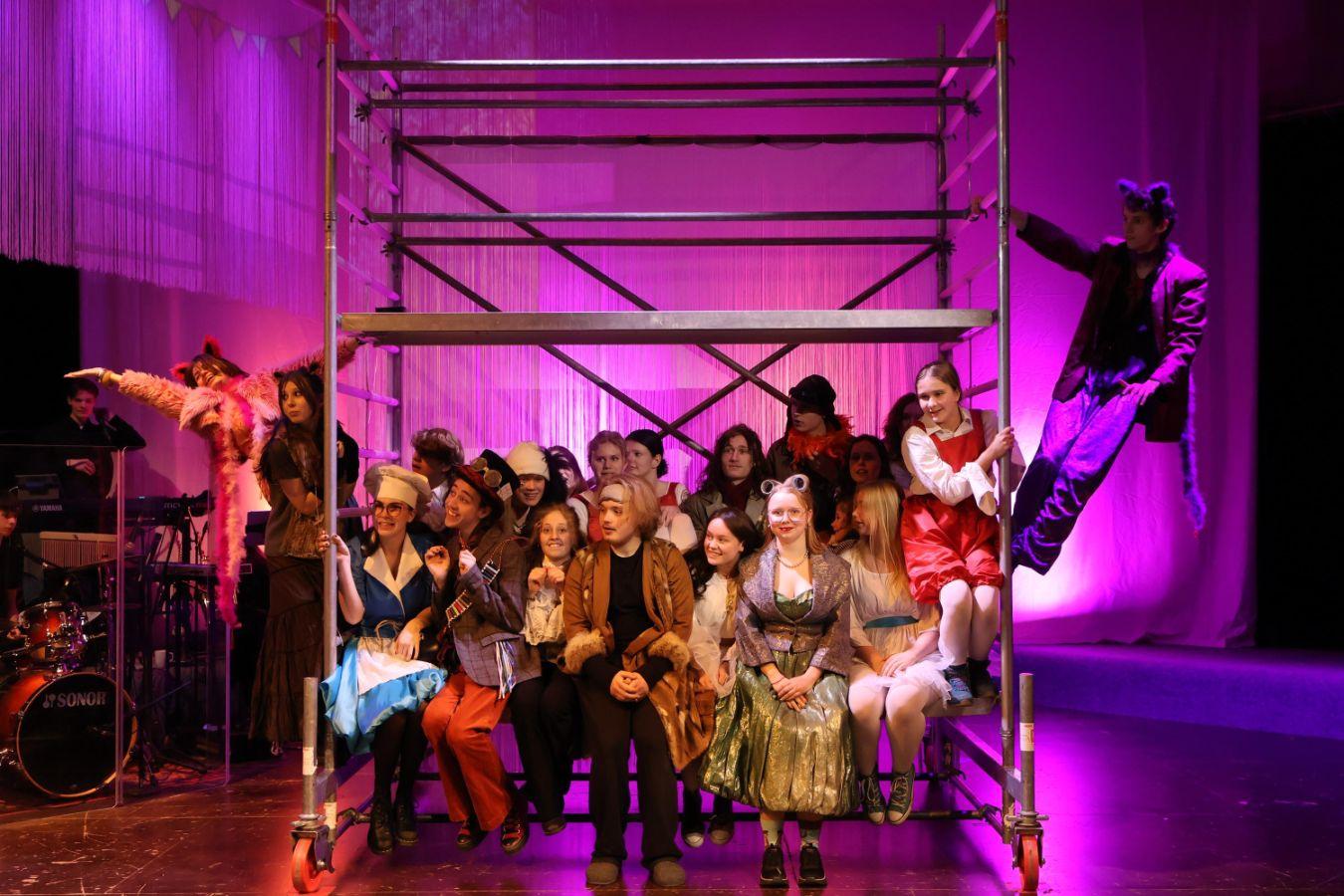
ALICE im Wunderl@nd, Theater AG der Georg-Christoph-Lichtenberg-Gesamtschule Göttingen © Laura Kohlhoff
Wonderland as a digital rabbit hole: students from IGS Göttingen-Geismar explore, in the musical theatre project ALICE im Wunderl@nd, the influence of social media platforms on young people’s identity formation and the vulnerability of democratic values. Supported by original compositions and songs by the band BanJo, they create their own distinctive Wonderland with great energy, humour and a clear political stance.
Inspired by the classic Alice in Wonderland, the people in the mixed-age theatre group set out in search of themselves and their place in society. Particular emphasis is placed on the challenges of the digital world and the impact of social media platforms on young people’s identity formation, as well as the vulnerability of democratic values. Through encounters with various influencers, Alice loses herself in a digital rabbit hole. In Wonderland, these influencers become bizarre figures who invite her to explore new perspectives and ways of life, overcome crises, take a political stance and gain insight – always guided by the questions: Who am I? How should I / how do I want to be? How may I be in a pluralistic and diverse society? In what kind of world do I want to live, and by which rules?
Attempts to navigate life amid constant influence and engagement with content from TikTok, Instagram and the like, in the midst of adolescence, are at the heart of the piece. The questions and concerns of young people in a time of multiple crises and the uncertainties of growing up are explored and developed through theatrical and musical means.
Songs specially written for the production by the band BanJo help to tell the story. They offer moments for reflection and create a distinctive Wonderland atmosphere.
Jury statement
Doomscrolling:
When you keep scrolling through all of your social media feeds, looking for the most recent upsetting news about the latest catastrophe. The amount of time spent doing this is directly proportional to how much worse you're going to feel after you're done.
“Dude! Stop doomscrolling, it's only going to make you feel worse!”
“I can't! The dopamine loop is too strong!”
- Urban Dictionary
In Alice's Adventures in Wonderland, Alice falls into Wonderland, a place whose rules she is mercilessly subjected to. She drifts aimlessly from one absurd situation to the next, encountering a host of bizarre characters along the way.
In the adaptation ALICE im Wunderl@nd by the theatre group of the Georg-Christoph-Lichtenberg comprehensive school in Göttingen, Alice tumbles headfirst into a different kind of rabbit hole – while doomscrolling on TikTok. Here, she is subject to the rules of social media, stumbling from one reel to the next. With consistently strong performances, the ensemble creates an atmosphere of the absurd through multifaceted and highly comic acting. Alice encounters autocratic structures, outdated images of women and an unsettled society that, in its search for freedom and identity, seems paralysed by uncertainty.
Once in Wonderland, the large ensemble conjures even more striking images: with elaborate costumes, a rousing live band and tremendous performative energy that does justice to the surreal nature of the original. Multiple casting is used creatively, and in its skilfully asymmetrical synchronisation evokes a dreamlike quality – a kind of hall of mirrors in another dimension.
In this adaptation, Alice does not remain passive; she refuses to stay silent or look away. She becomes the spark of a revolution. With a self-written song by the Disembodied Catterpilar, she politicises both the partygoing crowd and the audience – much to the Queen’s displeasure. Alice no longer stands by idly, but confronts the Queen.
She transforms the rabbit hole through which she initially entered Wonderland into a ring light and raises her voice – the final reel of the evening. She speaks out in favour of a vibrant, diverse society shaping its future together. We should all act with self-determination and stand up for our values – “because we are free, and we are loud!”
Ilias Botseas
With
Helena Anton, Ole Bartel, Emma Clara Di Bartolo, Lea Dormeyer, Findus Frerichs, Tomke Freymuth, Franka Hiller, Maja Jünemann, Helena Kessler, Madita Kuschel, Jette Laschke, Mara Neumann, Isalie Perschke, Florentine Peukert, Oskar Piskurek, Erik Röhling, Robyn Schlüter, Meije Schöningh, Marlene Strommer, Hannes Weberschock, Kai Winchell, Mia Windel, Bjarne Wolf, Jonte Wolf, Marlene Zachowski
Jule Lennartz – vocals and guitar
Michel Wesemann – bass & electric guitar
Lukas Baumann – keyboards
Janis Agster – drums
Oskar Piskurek – songwriting & vocals (Raupen-Song)
Agnes Giese, Laura Kohlhoff, Katrin Schultheis-Joos, Sebastian Wartini – management team
Jule Lennartz – musical direction & songwriting
Emil Kordowski, Oskar von Ohlen – technical direction
Gregor Ehmer, Lena Laschke, Len Stieg, Mathis Wöhrle – teamer
Elena Kortenhaus, Mathis Wöhrle – props & costumes
Ole Bartels, Emil Kordowski, Matthias Linnemann, Oskar von Ohlen – video design, reels & stage design
Mateo Di Bartolo, Lukas Enders, Milena Furcht, Moritz Großkopf, Julian Kantelhardt, Joost Linne, Len Loeser, Luis Müller, Luca Nitschke, Tjorven Sturm, Ryan Oberle – Forum technology