Treffen junge Szene
Production
ANNE
Piccolo Theater Jugendklub
Cottbus, Brandenburg
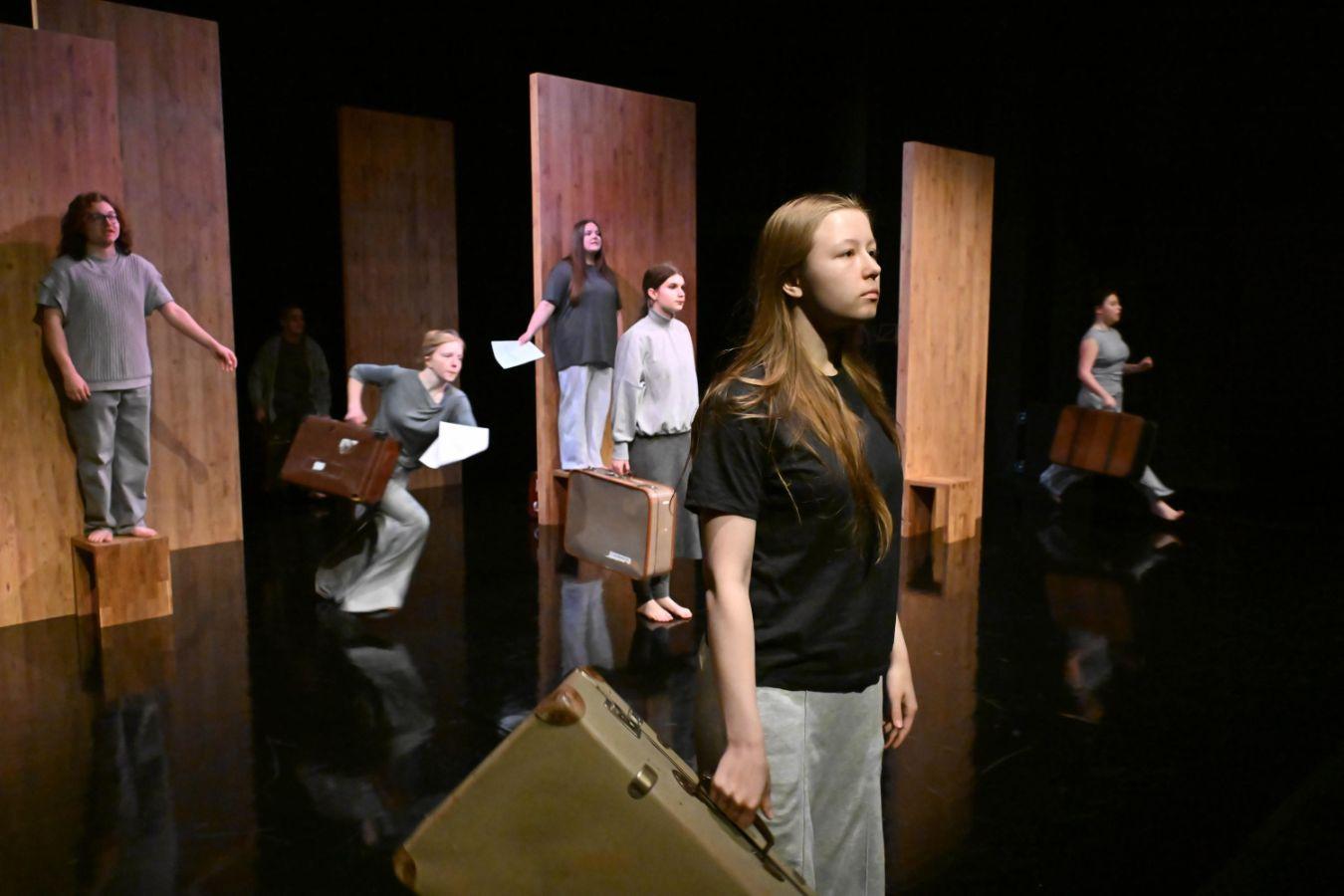
ANNE, Piccolo Theater Jugendklub, Piccolo Theater Cottbus © Michael Helbig
A production by the Piccolo youth theatre club, based on the diary of Anne Frank.
Anne Frank was murdered by the Nazis in 1945 in the Bergen-Belsen concentration camp. Before that, she had gone into hiding with her family in Amsterdam and recorded her thoughts in her famous diary. The youth theatre group engaged deeply with her life. How can rituals of remembrance be broken open in order to arrive at a form of remembrance that actively engages with the present?
Eighty-one years ago, on 8 May 1945, the End of World War II in Europe brought to a close the war unleashed by Nazi Germany. In six years, it had claimed around 60 million lives worldwide. One of them was the life of the fifteen-year-old Anne Frank. In February 1945, she was murdered in the Bergen-Belsen concentration camp. Only two months later, British troops reached the camp and liberated the remaining survivors. The Nazis had all but annihilated the Jewish population of Europe.
The Jewish girl Anne Frank went into hiding with her family during the Nazi occupation of the Netherlands, in the rear annex at Prinsengracht 263 in Amsterdam. After two years, they were betrayed and discovered. While in hiding, Anne wrote about life in the annex, recording her feelings and thoughts in her now famous diary.
In the 2024/25 season, the Piccolo youth theatre club engaged intensively with her life, work and death. The group travelled to Anne Frank House and approached her story through writing workshops and in-depth research. The performers, aged between 16 and 20, come from diverse backgrounds and also contributed Jewish perspectives to the creative process. The production premiered on 26 April 2025 at the Piccolo Theatre.
The Piccolo youth theatre club traces Anne’s remarkable life story to its end. How can rituals of remembrance be broken open in order to arrive at a form of remembrance that actively engages with the present?
This is no dusty retelling of a biography. Here, history is actively explored, questioned and translated into the performers’ own bodies. Under the direction of Matthias Heine, a stage production has emerged that draws its immense power directly from the attitudes, discussions and intensive research undertaken by the young performers.
To mark the 80th anniversary of the end of the war, the ensemble goes far beyond the well-known pages of Anne Frank’s diary. The young ensemble travelled to Amsterdam, conducted research on site and, through additional eyewitness accounts, ventured into those gaps in the historical record that the diary leaves open after Anne’s arrest. This depth of engagement is palpable in every moment: the ensemble has actively worked through the history and the figure of Anne Frank without claiming to embody her. With a conscious decision to maintain distance, they say: “I am playing Anne.” They approach her, quote her, and boldly place their own biographies alongside hers.
This accessible form of critical engagement lies at the heart of the performance. The performers weave their own questions into the text: how do we, in 2026, look at Anne’s fate today? What does freedom mean to us in the face of current conflicts? When we look ahead to 2029, what do we see? When the performers step out of their roles, recount their journey to Amsterdam or reflect on the current political situation, the piece becomes a searing document of the present. Through the dynamics of the group, simple steles are transformed into the oppressive narrowness of the annex, into the impenetrable walls of a hiding place. The ensemble operates as a striking choreographic unit.
ANNE is quiet and intense, yet dynamic in a deeply personal way. At several points, the action shifts into the audience: eyewitness accounts emerge from among the spectators, and excerpts of text are handed to the performers almost casually. The production skilfully interweaves Anne’s writings with the performers’ own questions and experiences. Moments of delicate intimacy arise – a longing for connection and friendship, or Anne’s first affection for Peter – only to be abruptly interrupted by the harsh contrast of reality.
The young ensemble has created a compelling piece that balances the lightness of Anne’s dreams with the weight of the crime in a remarkable way. In the end, seven pairs of red shoes stand illuminated – a symbol of remembrance and, at the same time, a warning. ANNE is courageous, aesthetically coherent and a powerful testament to how impactful youth theatre can be when it uses its own voice as a compass and leaves us reflecting on our own stance.
Andreas Kroder and Fernando da Ponte
With
Frieda Becker, Hermine Jähne, Maja Kuschnir, Laurenz Lorenz, Charlie Müller, Weronika Muisalowska, Lena Patzelt, Lamara Schröder, Celina Siegfried, Isabella Stutzmann, Carl Ferdinand Thomas und Arian Wolff
Matthias Heine – Direction, adaptation, writing workshops, dramaturgy
Zaida Ballesteros Parejo – Choreography
Sven Mühlbach, Konstantin Walter – Lighting, technical support, music
Matthias Heine, Veronica Silva-Klug – Stage design and costumes