Treffen junge Szene
Production
Zum Lachen in den Keller
LABYRINTH Theater
Stuttgart, Baden Württemberg
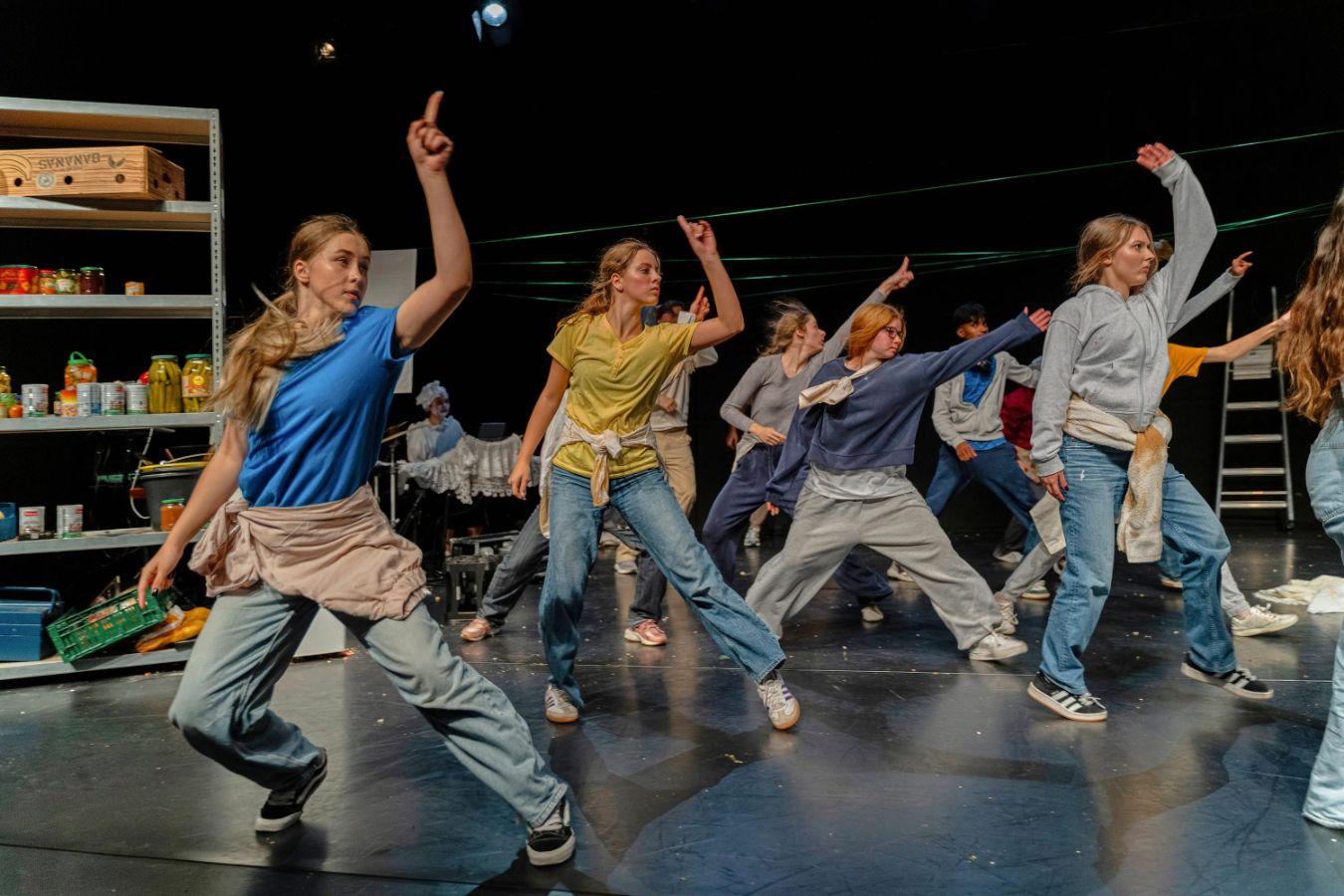
Zum Lachen in den Keller, LABYRINTH Theater Stuttgart © Ronny Schonebaum / Dominique Brewig
Zum Lachen in den Keller asks: what does it mean to grow up – especially with experiences of flight or migration? What uncertainties, fears and detours are part of that journey? The young performers find expression for their themes through music, dance, theatre and puppetry.
Zum Lachen in den Keller is a moving journey into the hidden spaces of our inner world.
We are in a basement – perhaps of an apartment building, perhaps in a big city. The visitors arrive for very different reasons: to sort crates of drinks, to meet a secret lover, to satisfy their hunger or to hide. But the basement follows its own logic: it opens hidden spaces, awakens memories, relives powerlessness and loss, and breaks taboos.
Here, people wash, tinker and stack things away – and sometimes celebrate without restraint, dancing, singing and devouring. Between shadows and ghosts, boundaries begin to blur. The basement: a place of darkness and loneliness, but also of freedom and insight. Among shelves of provisions and washing lines, people encounter not only social norms and their own emotions, but also find themselves on the threshold of adulthood.
Zum Lachen in den Keller asks: what does it mean to grow up – especially with experiences of flight or migration? What uncertainties, fears and detours are part of that journey? The young performers use music, dance, theatre and puppetry to explore their themes. Under the guidance of experienced artists trained in trauma-informed practice, a safe space is created in which they can express themselves with courage, honesty and energy. Scenes from their lived realities merge into a larger whole, making stories visible and contributing to an open, democratic society.
Zum Lachen in den Keller is a moving journey into the hidden spaces of our inner world. At times genuinely funny, at others deeply sombre, the performance opens doors that usually remain closed – and poses a direct question to the audience: what are you ashamed of?
Jury statement
The German idiom „zum Lachen in den Keller gehen“ describes someone who is humourless and very serious – a person who does not show joy or laughter in public. Someone who, figuratively speaking, goes down to the basement to laugh is inhibited and keeps their emotions hidden.
At the entrance, we are personally welcomed by basement-dwelling figures wearing white masks. They read our palms and guide us down the stairs into the auditorium. Once inside, we see a classic cellar setting: storage shelves, a band with a drum kit, washing lines and piles of laundry. An ordinary basement – yet for the group it is many things at once: a place to store food, a laundry room, a shelter, a retreat, a party space, and also something slightly eerie.
Over the course of an hour, 17 young people aged 14 to 21 share their stories. We encounter performers with and without experiences of displacement, from Syria, Afghanistan, Sri Lanka, Paraguay, Ukraine, Germany and Romania. They take us into the hidden spaces of their inner worlds, opening doors that would otherwise remain closed. The group combines theatre with music, dance and puppetry. The white masked figures support those who enter the space, accompanying them and listening when the weight of memories becomes too great.
The ensemble weaves together their individual themes and brings to the stage emotions they might otherwise keep concealed. In this basement, everyone feels safe; they support one another and create space for each other. Here, many questions are explored: what does it mean to grow up in the context of displacement and migration? What uncertainties, fears and detours are part of that journey? Which taboos come to light in the basement? How do we learn German, and how does language shape us? What do we consider fun – and what makes us laugh? Which feelings do we prefer to keep to ourselves? How do we relate to food, and what challenges do we face with our own bodies?
Issues such as body shame and eating disorders are addressed with striking openness. This openness also prompts questions for us as an audience: what are we ashamed of? What parts of ourselves would we rather hide? The collective songs performed by the group carry a particular emotional power.
In this way, the young people’s questions become questions for the audience as well. We must decide whether to speak about our shame or to conceal it. Perhaps we remain a little longer in the basement, allowing the white figures to hold us, sharing why we come here to laugh at all. Perhaps we listen more attentively – to the ensemble, but also to one another. And perhaps we find the courage to reveal our own imperfections and learn, together, a language of care and respect.
Andreas Kroder and Fernando da Ponte
With
Daria Ariton, Anna Biletska, Yuri Gomez, Nadiia Kot, Lukas Krug, Vitalii Kulyk, Viktoriia Levkovska, Vsevolod Liashenko, Lava Mousa, Anastasiia Pavlenko, Alex Popenko, Milana Rosliakova, Kateryna Rozlomii, Said Shubat, Sonatullah Uzbek, Abeesnavan Vimalathas, Alina Nika Zaluzhna
Lena Bäuerle – Vocal coaching, choral work and live music
Patrizia Birkenberg – Project management and concept
Thea Marie Eilers – Theatre education, text production
Esther Falk – Puppet construction & performance, costumes, dramaturgy
Yahi Nestor Gahe – Movement training & choreography
Johannes Reischmann – Music production, musical arrangement and live music