The 10 most remarkable productions
Mephisto
based on the novel of a career by Klaus Mann
Münchner Kammerspiele
Premiere: 28.2.2025

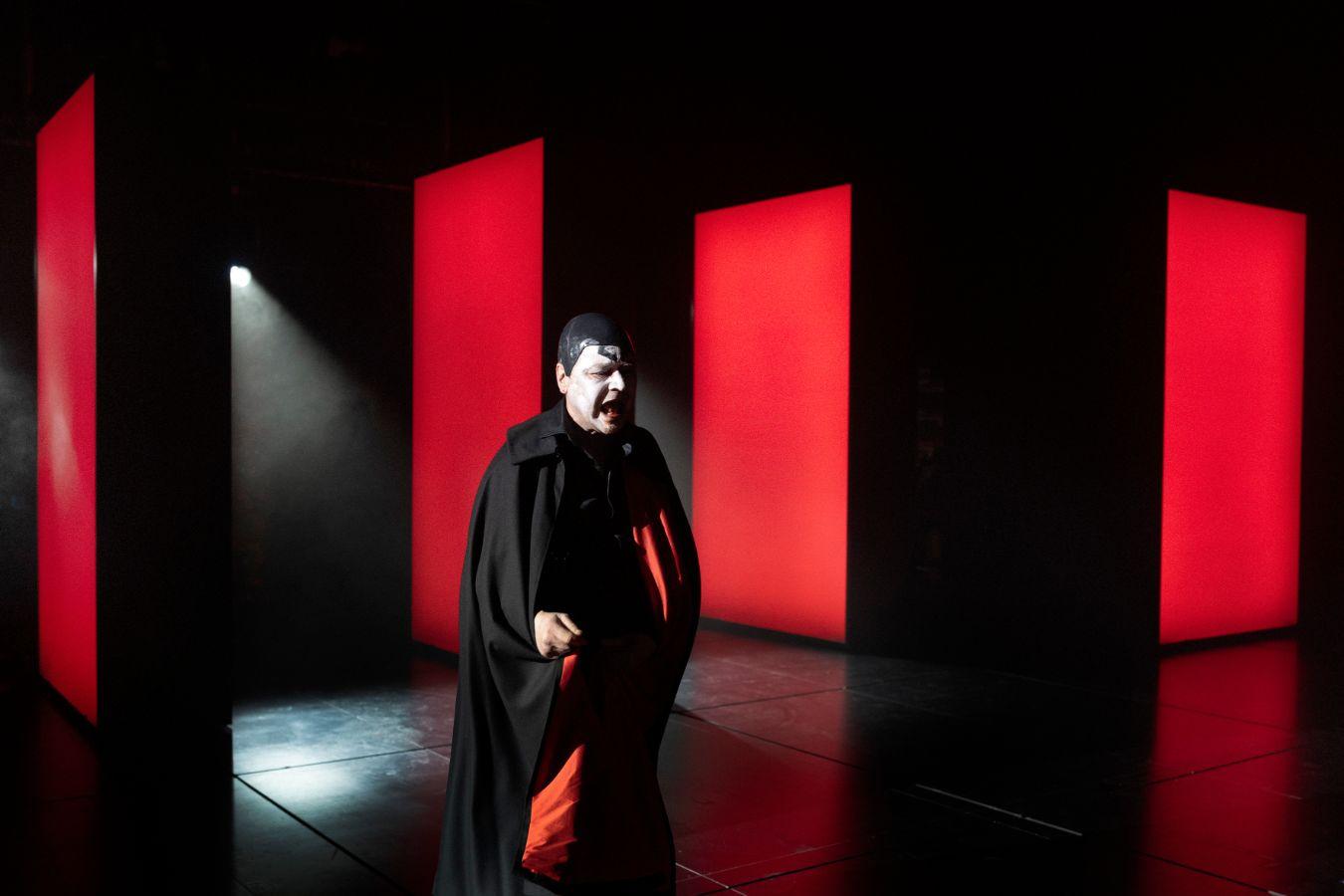
Mephisto © Münchner Kammerspiele
In Mephisto Jette Steckel and her outstanding ensemble stage an actor’s high wire act between pursuing personal advantage and criticising the system, while examining the issue of artistic freedom in an authoritarian regime in poetic, clear and finely composed scenes.
The actor Hendrik Höfgen is about to ascend to the peak of his career: he joins the Prussian State Theatre in Berlin, performs brilliantly as Mephistopheles in Goethe’s Faust and is ultimately appointed Artistic Director by the Prime Minister. But his elevation has its price: Höfgen makes a pact with the Nazi regime and becomes caught up in the role of a lifetime. Klaus Mann’s novel Mephisto is seen as a seminal work of post-war literature, examining the actions and responsibilities of the individual in an authoritarian regime and inspired by real lives. All the action in Jette Steckel’s haunting and intelligent production takes place inside the theatre. This highlights the role of artists in the theatre system and produces a feast of acting: the ensemble is in top form, led by Thomas Schmauser in a sophisticated and memorable performance: a genuine event that enables us to see the main character’s internal conflicts.
Jury Statement
“Jette Steckel and her team have succeeded in creating an evening that shapes Klaus Mann’s novel Mephisto plus a few lines added from other sources into a trenchant and topical study of the relationship between art and power. Thomas Schmauser offers a virtuoso portrayal of Hendrik Höfgen’s transformation from the pioneer of a ‘revolutionary theatre’ to an opportunistic Nazi favourite motivated by a mixture of artistic vanity and some residual ideas about resistance. He carefully explores the character from the inside, showing him to be flawed, argumentative and/or acting being argumentative. That Steckel shows even this evening’s domestic scenes as a play within a play is entirely consistent. This is a portrait of a human type to whom art means the world, one committed to the illusion that the theatre is a refuge that will ultimately remain inviolate. No way! Watching this superb ensemble at work, we see people whom the New Right would be only too happy to exclude from the stage. This alignment between the historical past and the potential future really hurts.”
– Sabine Leucht for the Theatertreffen-jury
Tothe video statement (in German)
DigitalProgramme Booklet on the website of Münchner Kammerspiele (in German)
Artistic Team
Jette Steckel – Direction
Florian Lösche – Stage Design
Pauline Hüners – Costume Design
Mark Badur, Elias Krischke – Music
Maximilian Kraußmüller – Lighting Design
Emilia Heinrich, Jette Steckel, Johanna Höhmann – Stage Adaptation
Johanna Höhmann, Theresa Schlesinger, Carl Hegemann – Dramaturgy
Cast
Thomas Schmauser – Hendrik Höfgen
Erwin Aljukić – Theophil Marder, Cäsar von Muck, Gottfried Benn
Bless Amada – Julien Martens
Johanna Eiworth – Dora Martin, Lotte Lindenthal
Elias Krischke – Hans Miklas, Live Percussion and Vibraphone
Linda Pöppel – Barbara Bruckner
Maren Solty – Nicoletta von Niebuhr
Edmund Telgenkämper – Artistic Director Kroge, Professor, Prime Minister
Martin Weigel – Otto Ulrichs
Mephisto
© Armin Smailovic

Mephisto
© Armin Smailovic

Mephisto
© Armin Smailovic

Mephisto
© Armin Smailovic
Mephisto
© Armin Smailovic
Mephisto
© Armin Smailovic
Mephisto
© Armin Smailovic
Mephisto
© Armin Smailovic
Mephisto
© Armin Smailovic
Mephisto
© Armin Smailovic
Mephisto
© Armin Smailovic
Mephisto
© Armin Smailovic