
Time Slots and Tickets
Play Space
BAUBAU
A Play Space for Kids
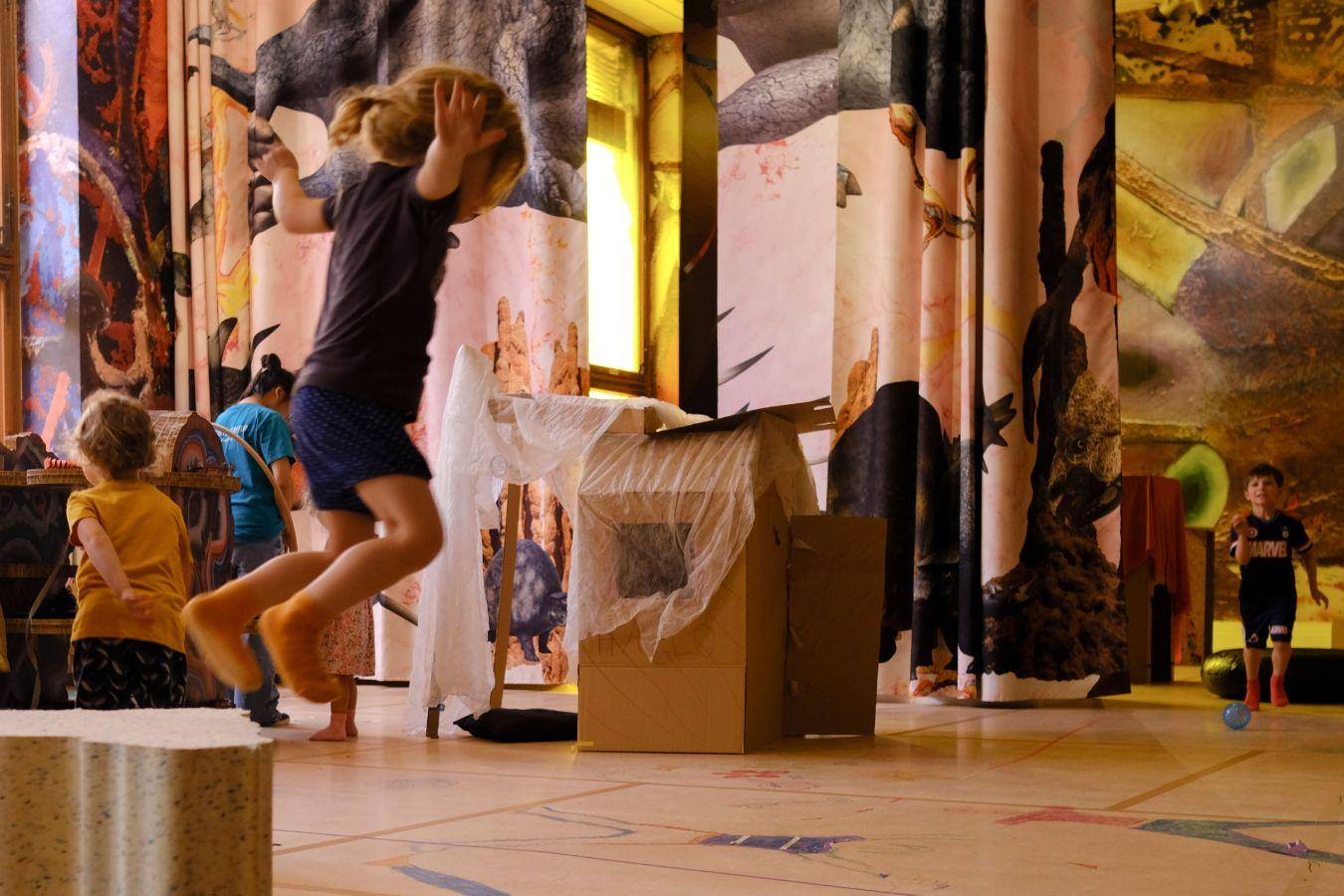
BAUBAU © Gropius Bau, photo: Guannan Li
Mon, Wed, Thu, Fri: 12:00–18:00
Sat & Sun: 10:00–18:00
Tue closed
Open for all kids (with an accompanying adult)
Please book a free ticket in advance for your visit. Admission cannot be guaranteed without a ticket. More details can be found under Your Visit
Playing, laughing, making noise, letting off steam, doing nothing – all in an exhibition venue! With BAUBAU, the artist Kerstin Brätsch designed an admission-free play space for kids, where more is allowed than forbidden. On Gropius Bau’s ground floor, colourful wallpapers, structures, objects and open-ended material called “loose parts” configure flexible spaces that are shaped by children’s activities. They set the tone and decide what happens in this place.
How to... BAUBAU
Perhaps children can tell us so much about their own world that it can also be a model for us?
— Palle Nielsen
Play
Every child has the urge to play. This is how they learn to understand themselves in relation to the world. Open-ended, self-directed play is of particular importance to a child’s emotional and social development. Accordingly, the pedagogical concept of BAUBAU is fundamentally about play: here, children have time, space and permission to explore their own needs and interests. And they can do this in the company of “playworkers” – trained staff who create a safe and supportive environment for the children.

BAUBAU: A Play Space for Kids, Gropius Bau, 2024
© Gropius Bau, photo: Guannan Li

BAUBAU: A Play Space for Kids, Gropius Bau, 2024
© Gropius Bau, photo: Guannan Li

BAUBAU: A Play Space for Kids, Gropius Bau, 2024
© Gropius Bau, photo: Guannan Li

BAUBAU: A Play Space for Kids, Gropius Bau, 2024
© Gropius Bau, photo: Guannan Li

BAUBAU: A Play Space for Kids, Gropius Bau, 2024
© Gropius Bau, photo: Guannan Li

BAUBAU: A Play Space for Kids, Gropius Bau, 2024
© Gropius Bau, photo: Guannan Li
The Art
BAUBAU is inspired by The Model – an adventure playground installed at Stockholm’s Moderna Museet in 1968, which was devised by the artist and activist Palle Nielsen and the journalist and activist Gunilla Lundahl. Following the principles of adventure playgrounds, the everyday rules of art institutions don’t apply here: children have free reign and can have fun.
The multi-faceted interior created by Kerstin Brätsch is filled with references and the potential for inspiration. Elements from her own work – including marblings, paintings and stucco pieces – reappear here in various guises and new materials. Wallpapers, curtains, fabrics, seatings and other objects feature dinosaurs, fantastical beings, termite mounds and abstract elements. Their humorous, perhaps even uncanny presence creates an open scenario to play in.
Brätsch’s practice is all about absorbing and embracing outside influences. Having previously worked with artists and craftspeople, she is now working with children in a very different way. She conceives of the space as an open invitation to children to change and develop it in unpredictable ways. They can do so according to their own ideas and whims, without the artist’s input.
Curated by Jenny Schlenzka, Director, Patrizia Dander, Deputy Director of Curatorial Affairs, and Sonja Borstner, Assistant Curator