Exhibition Texts
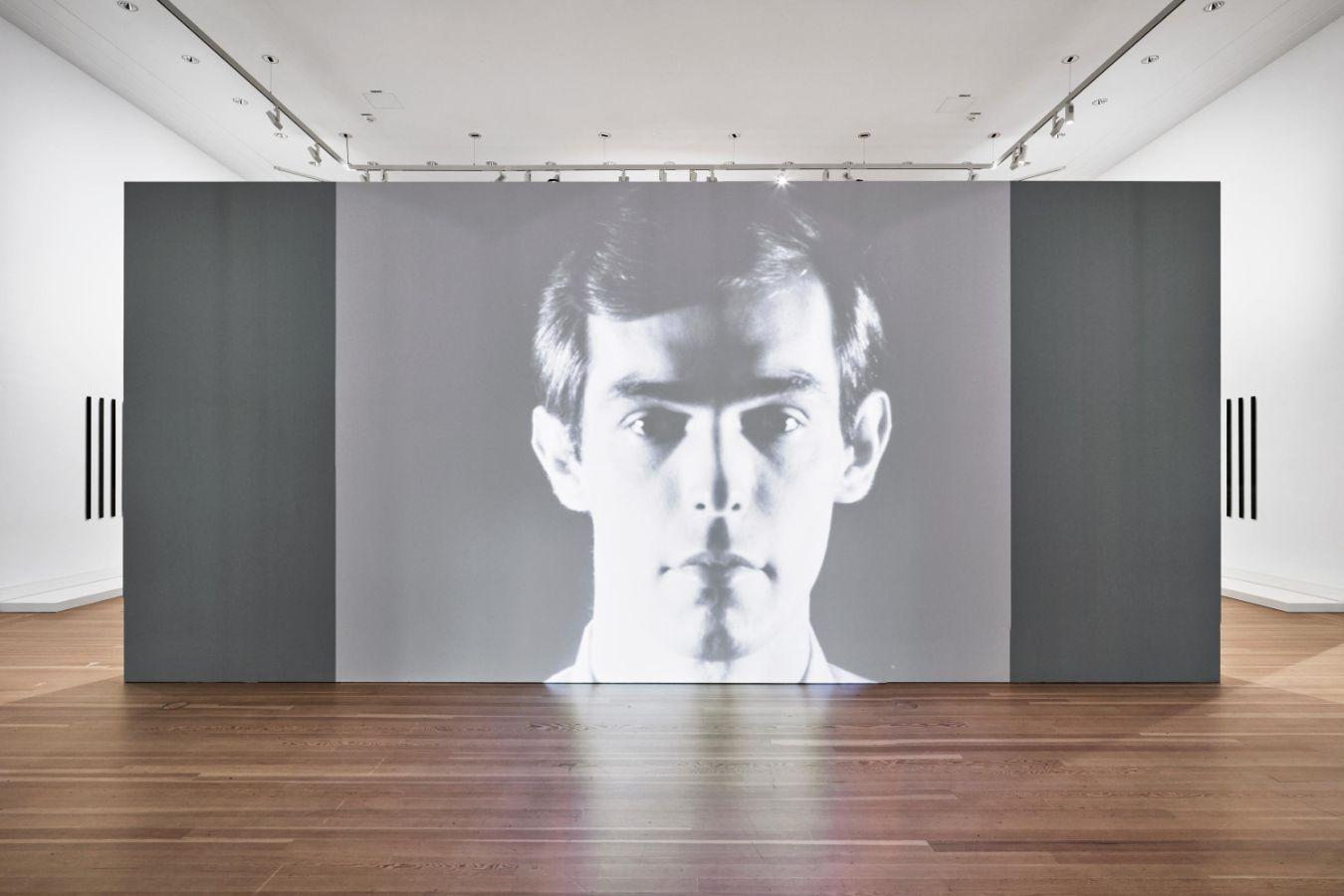
Peter Hujar / Liz Deschenes: Persistence of Vision, installation view, Gropius Bau, 2026
© Gropius Bau, photo: Luca Girardini
Introduction
Peter Hujar / Liz Deschenes: Persistence of Vision is an intergenerational conversation between artists that proposes an expansive understanding of photography.
The exhibition traces Peter Hujar’s career from early photographic experiments to his mature studio works. Working in New York City between the rise of the gay liberation movement in the 1960s and the emergence of the AIDS crisis in the 1980s, Hujar captured a pivotal cultural moment. He is best known for his piercing black-and-white portraits of New York City’s avant-garde and queer communities. His incisive images of animals and nature, along with his haunting pictures of urban ruins, explore themes of community, sexuality, decay and death. Above all, Hujar sought authenticity and clarity in his pictures, aiming to create what he described as uncomplicated pictures of complicated subjects.
Hujar’s photographs are interspersed with contemporary work by New York City-based artist Liz Deschenes. These interludes invite you to pause and consider Hujar’s work in a new light. Deschenes makes sculptures and non-representational photographic work. Using the fundamental properties of the medium – light, chemistry and time – she questions what a photograph can be. Although Hujar and Deschenes never met and their styles are distinct from one another, both share a deep interest in the material possibilities of photography, architecture and the role of beauty.
Grids and Differences
The grid installations, which appear in various rooms throughout the exhibition, take Peter Hujar’s last show during his lifetime as inspiration. Peter Hujar: Recent Photographs was staged in 1986 at Gracie Mansion Gallery, an influential experimental gallery in New York City’s East Village.
Working with artist and AIDS activist Sur Rodney (Sur), who was co-director of the gallery at the time, Hujar hung his photographs in a tight, apparently random grid. Whether depicting nudes, portraits, animals or ruins, the works formed an ensemble that defied categorisation. Central to Hujar’s thinking was the power that laid in difference – a difference which he saw as the unique essence of each person and subject he photographed. Hujar’s method is echoed in this exhibition’s grid installations, evoking his enduring vision of capturing his subjects with remarkable clarity and rigor.
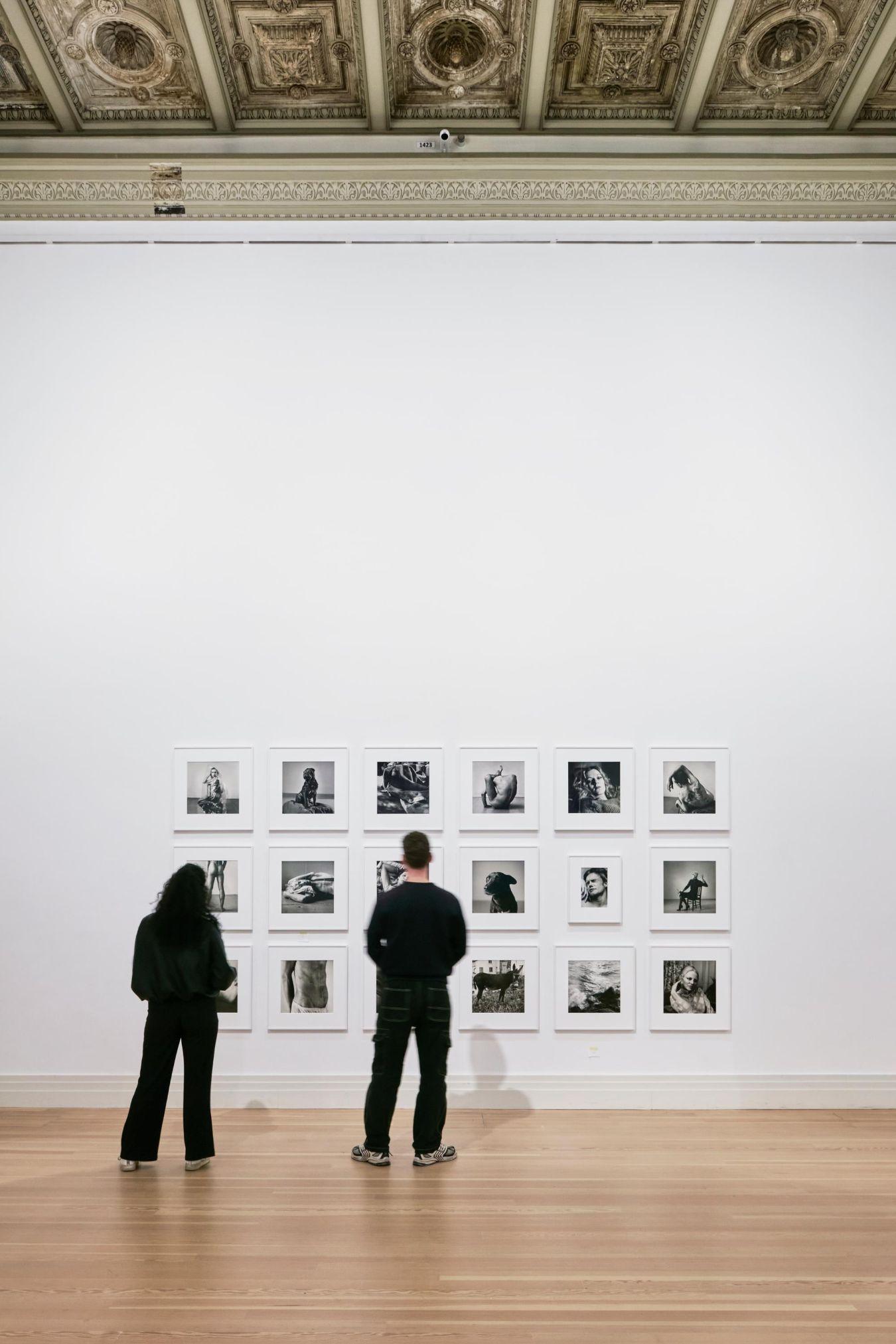
Peter Hujar / Liz Deschenes: Persistence of Vision, installation view, Gropius Bau, 2026
© Gropius Bau, photo: Luca Girardini
Ruins and Supports
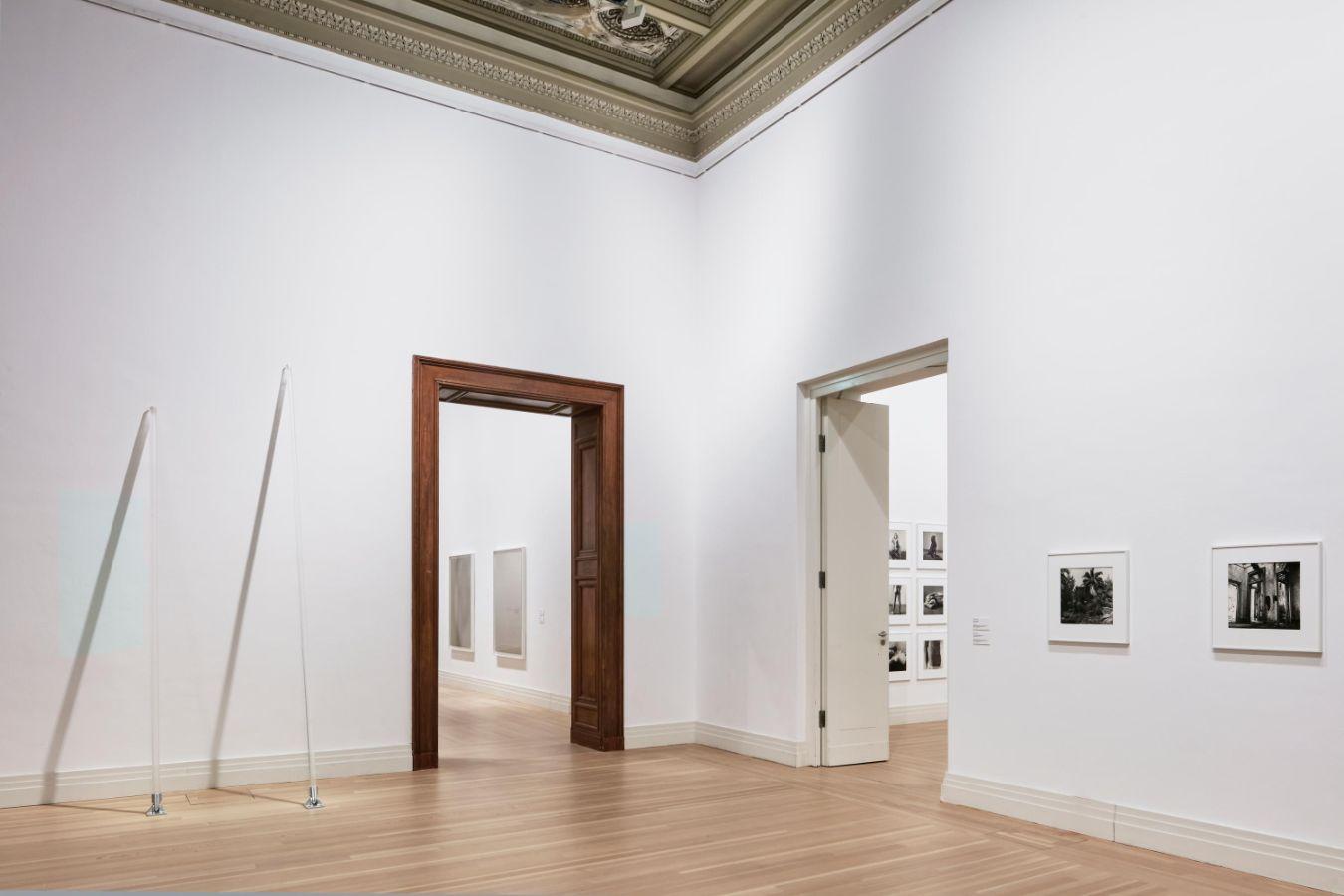
Peter Hujar / Liz Deschenes: Persistence of Vision, installation view, Gropius Bau, 2026
© Gropius Bau, photo: Luca Girardini
Important themes of Peter Hujar’s and Liz Deschenes’ work are the built environment and its relation to the passage of time. In this gallery, the space itself becomes part of the conversation. The ornate ceiling points to Gropius Bau’s architectural legacy as a neo-Renaissance building, which was partially bombed during World War II.
Hujar took photographs of ruins throughout his career: from an overgrown structure in Key West, Florida, to pictures of industrial waste in New Jersey, to images of abandoned piers on New York City’s West Side reclaimed by queer communities and artists. For Hujar, these sites were spaces of freedom and transgression, but also poignant metaphors for loss and decay.
Deschenes’ Retaining sculptures are inspired by scaffolding systems used to hold up unstable historical buildings for their preservation. However, her sculptures are made from delicate cast glass, suggesting that these fragile poles are not providing support, but drawing attention to the existing architecture by reframing it.
Night and Exposure
Peter Hujar and Liz Deschenes both engage with night not just as a subject, but as a medium itself. While Hujar took pictures of New York City at night, Deschenes uses moonlight to make camera-less photograms.
Cinematic and melancholy, Hujar’s night photographs are devoid of people and feature darkened buildings, alleyways and parked cars in desolate areas across the city. Hujar used available light and long exposures to make these pictures. The deep blacks and luminous highlights were further brought out during the printing process, adding to their atmospheric quality. Many were shot in areas known for cruising – a queer practice of seeking anonymous sexual encounters in public spaces – evoking a sense of longing and desire.
To make her photograms, Deschenes exposes black and white photographic paper to natural and artificial light emitted outdoors at night and uses chemicals to fix and process the exposure. The photograms remain sensitive to ambient light, transforming them into durational works that are influenced over time by oxidation and environmental factors, even as they are exhibited in this gallery.
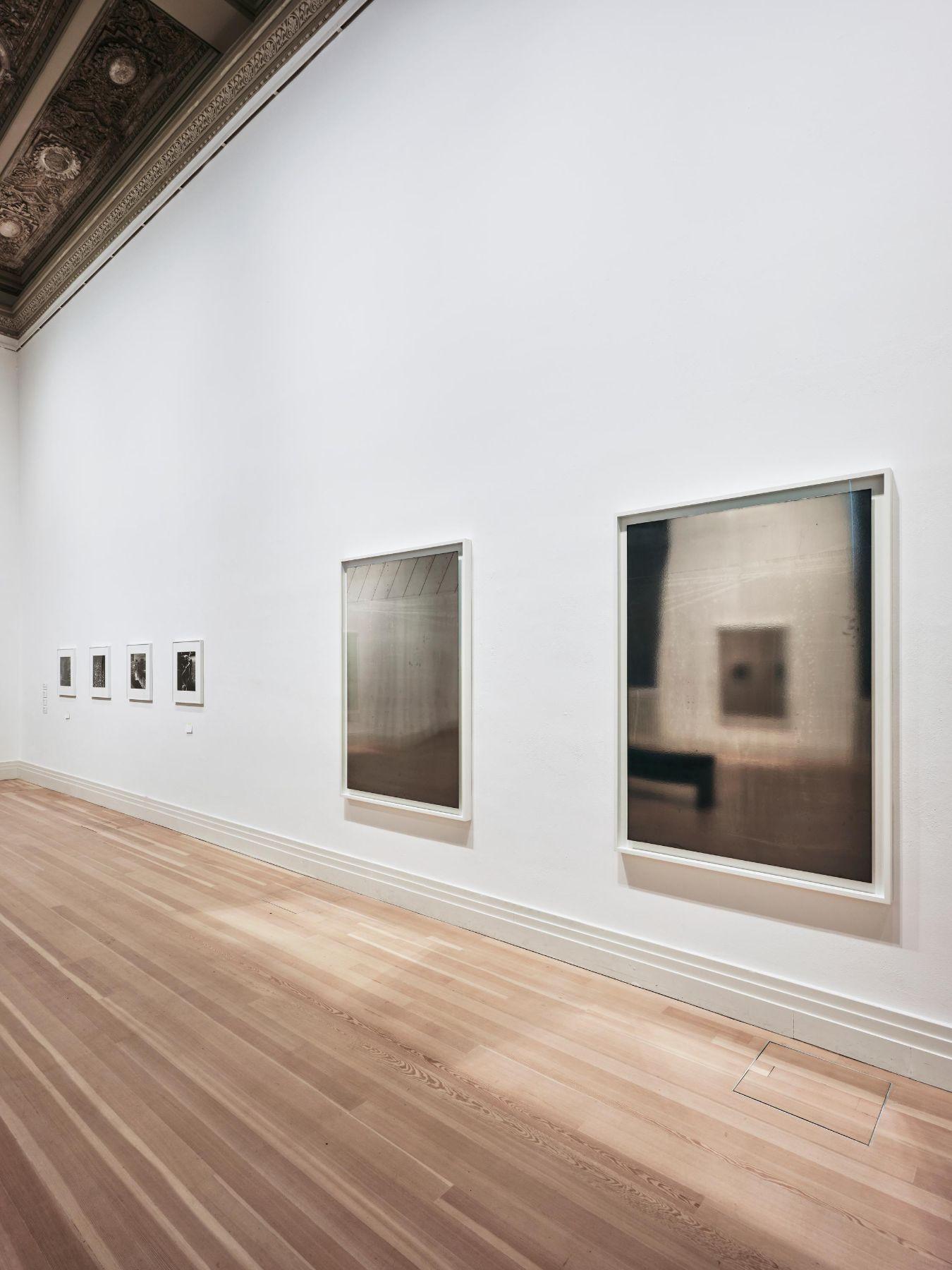
Peter Hujar / Liz Deschenes: Persistence of Vision, installation view, Gropius Bau, 2026
© Gropius Bau, photo: Luca Girardini
Fluidity and Reflection
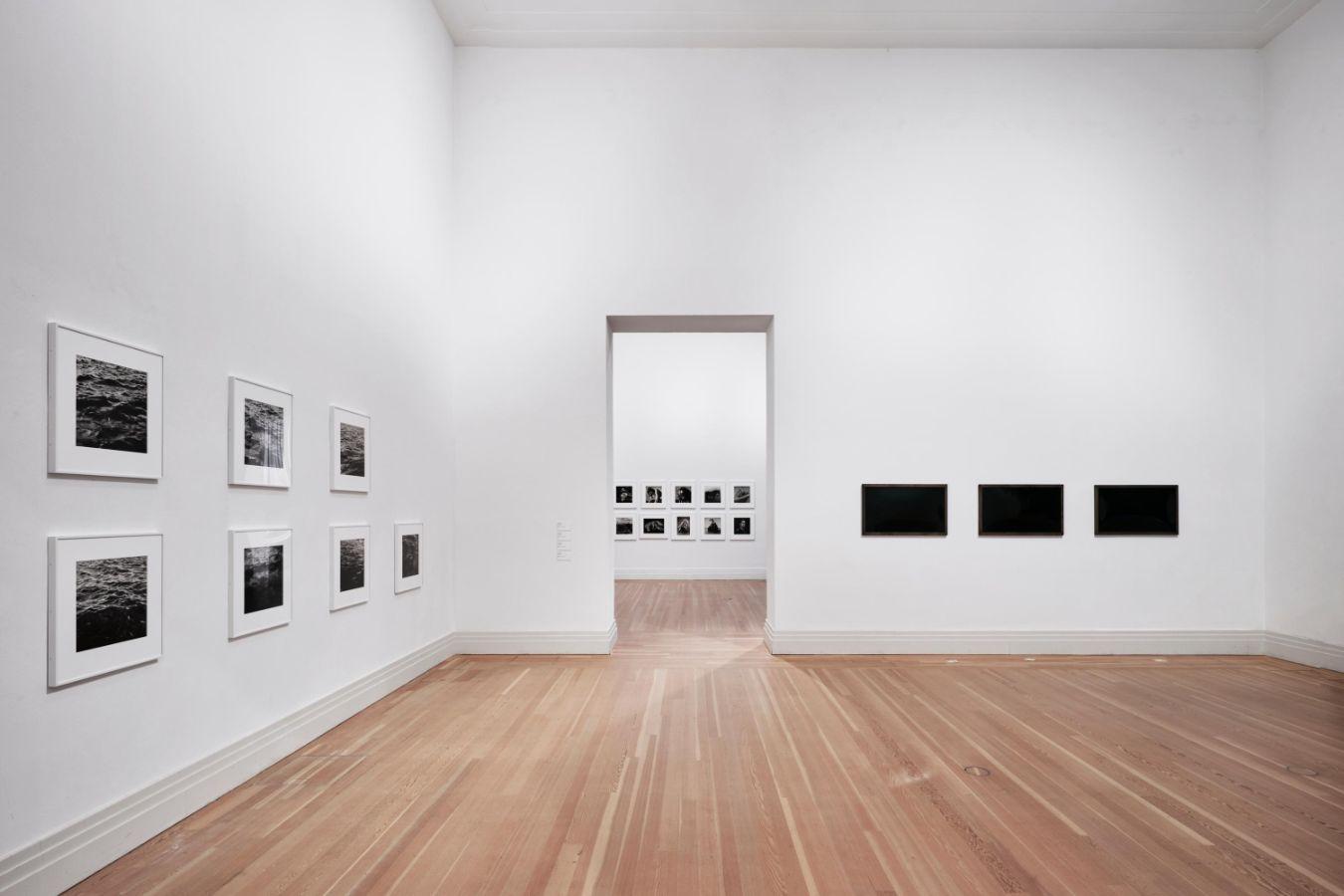
Peter Hujar / Liz Deschenes: Persistence of Vision, installation view, Gropius Bau, 2026
© Gropius Bau, photo: Luca Girardini
The myriad ways in which photography captures and transforms our experience of nature are key to both Peter Hujar’s and Liz Deschenes’ work.
Hujar’s close-up photographs of the East River and the Hudson River, the two rivers that border Manhattan, capture an in-between space where city and nature meet. Hujar’s compositions picture ripples, swirling currents and light playing on the water’s surface, revealing moments of flux and abstraction. Oscillating between transparency and opacity, they capture a state of fluidity at odds with a notion of photography as a static medium.
Deschenes’ Claude Glass works are inspired by a historical optical device. Typically made from polished black stone, the Claude glass was a tool used by landscape painters from the 17th century onwards. By reflecting the surrounding scenery in its curved surface, the device simplified colour and tonal range. Deschenes transforms this tool into a cast glass sculpture that no longer serves to reflect nature, but instead explores surface, perception and abstraction. Her practice highlights the concept of aesthetic transformation by the continual disruption of established photographic conventions.
Transparency and Filters
Liz Deschenes’ Gorilla Glass works are printed on ultra-thin glass engineered for screen displays and phones. Suspended from the ceiling as a series of solid-coloured panes, these sleek surfaces catch and reflect the natural light that filters through the windows. Like the Claude Glass works, they point to a 17th-century viewing apparatus. Here, the reference is to small, coloured glass filters used by painters to alter and heighten both hue and saturations of the landscapes before them. The linen wall coverings framing this space evoke shifting historical notions of display within museum presentation practices.
Unlike our digital screens, which force a single perspective upon the user, Deschenes’ works hang in space, without a definitive front or back. Outside the room, a layered and violent past confronts the viewers: the window offers a view of the Berlin House of Representatives – which formed part of the Ministry of Aviation under the Nazi regime – and remnants of the Berlin Wall. Deschenes’ pieces become another kind of window. They are reflective and silent witnesses to a built environment shaped by surveillance and terror.
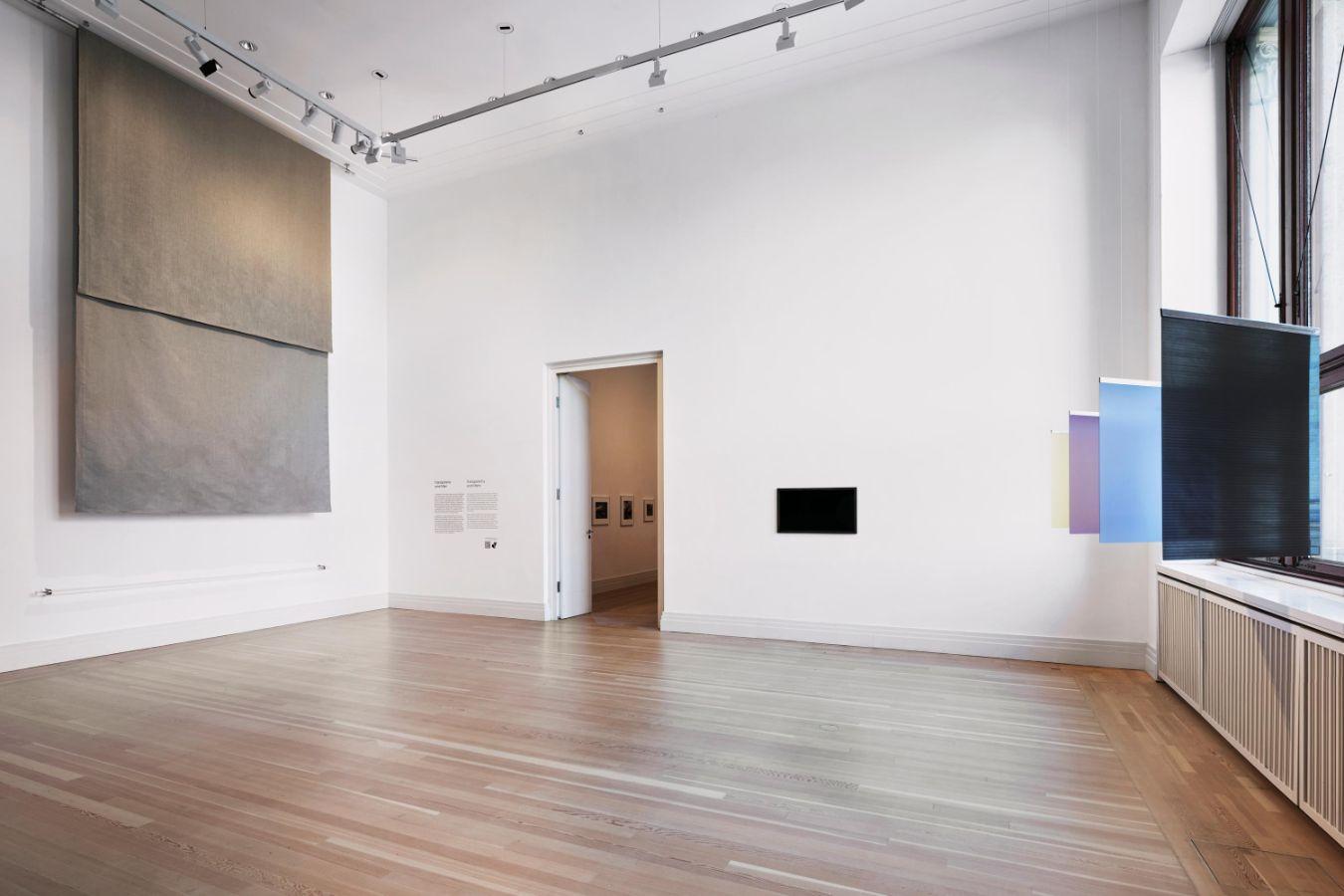
Peter Hujar / Liz Deschenes: Persistence of Vision, installation view, Gropius Bau, 2026
© Gropius Bau, photo: Luca Girardini
“I make uncomplicated, direct photographs of complicated and difficult subjects.”
— Peter Hujar
Peter Hujar (1934–1987) was raised by his Ukrainian grandparents in a semirural New Jersey community. As a child, he began to document the animals and farm life surrounding his family’s house, using his mother’s camera. At the age of twelve, he moved to New York City to live with his mother and stepfather.
In high school, an English teacher recognised his potential and encouraged him to pursue photography. Upon graduating, Hujar worked as an assistant to editorial photographers and used the studios’ darkrooms to make his own prints. A Fulbright scholarship took him to Italy in 1962, where he studied film and travelled extensively. A visit to the Palermo Catacombs with his then-partner Paul Thek left a deep impression and sparked a lasting concern with mortality. Back in New York City, Hujar socialised with fellow artists, writers and performers active in the East Village, portraying iconic figures such as Candy Darling, William S. Burroughs and Susan Sontag. A masterclass with photographer Richard Avedon in 1967 marked a turning point for Hujar: it led him to leave his commercial photography job and dedicate himself fully to his artistic practice. Hujar’s work spans a tumultuous three decades of avant-garde and queer life between the 1969 Stonewall uprising against police violence within the queer community and the AIDS crisis of the 1980s. His photographs serve as documentation of the persistent efforts to carve out spaces of resistance.
Known for his uncompromising character and meticulous control over how his work was presented, Hujar never achieved mainstream success during his lifetime. It was only after his passing due to an AIDS-related illness that his photographic work gained wider recognition and admiration.
“My work is often in reaction to the limited scope that photography is typically understood by. I think photography is capable of much more than representing a particular moment in time.”
— Liz Deschenes
Liz Deschenes was born in Boston in 1966 and lives and works in New York City. She earned her Bachelor of Fine Arts degree from Rhode Island School of Design, where she studied broadly with a concentration in Photography. She currently teaches in graduate programmes in New York City, with an emphasis on interdisciplinary pursuits and research.
Deschenes has explored the fundamental properties of photography – light, chemistry and time – and implemented newer printing technologies and substrates. One of her more frequently recurring mediums is glass, both as a printed surface and in sculptural works without a photographic component. In all her work, Deschenes pushes the boundaries of medium-specificity and questions what a photograph can be.
Deschenes’ distinct visual language resists fixed meanings, emphasising photography’s inherent fluidity. Many of her works acquire architectural qualities, reframing the space they inhabit. In her sculpture, she explores how viewers move through space and encounter art in relation to architecture. Through spatial arrangements that shift with the viewer’s position, Deschenes’ work poetically addresses the conditions of perception: through which devices – bodily and technological – do we experience the world?