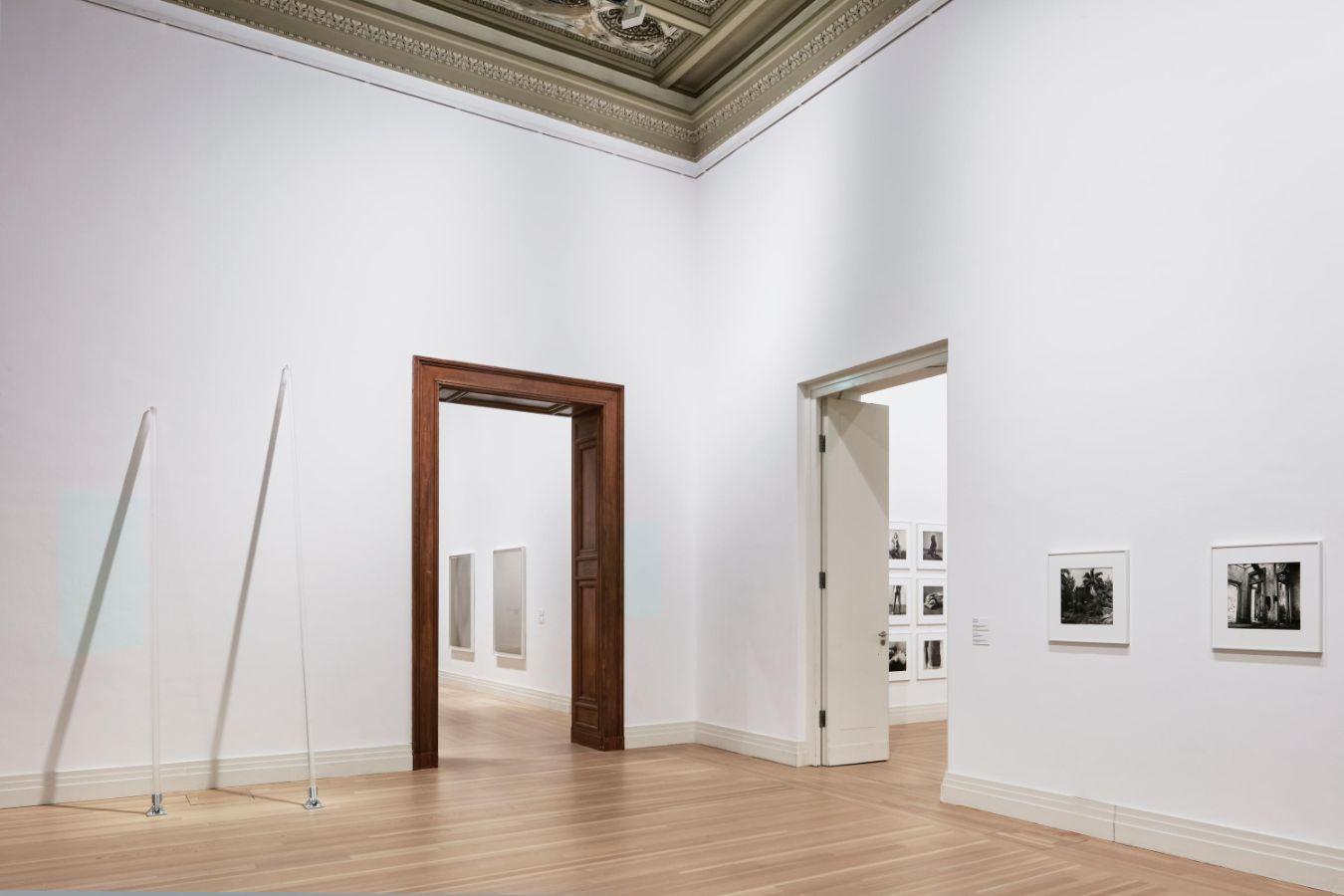
Peter Hujar / Liz Deschenes: Persistence of Vision, installation view, Gropius Bau, 2026
© Gropius Bau, photo: Luca Girardini
Essay
Let’s Assume, at Least, That the Big Picture Isn’t a Rectangle
Maxi Wallenhorst
To say that his photographs show us ways of life that no longer exist, so completely transformed beyond recognition by luxury developments, AIDS, the police, has become almost a commonplace in writing on Peter Hujar. That doesn’t mean that it’s not, brutally – and increasingly – true. The overlap between sexual cultures and scenic glamour that makes his portraits glow with specificity is being displaced, and the displacement is ongoing. It hits us in waves and we’re getting absolutely rag-dolled right now. At the same time, the mythical New York that we see (not even) reflected in the Hudson River curls in Hujar’s photos from the early 1970s, never existed in the first place. It’s physically impossible not to retroject into Hujar’s work, into these intimately public orgasms and aggressively spacious lofts, the image of a city that seems capacious: abandoned, ruined, sick, but viscerally liveable. However, this is not a place that Hujar merely documented nor one that he was politically advocating for; it is a fantasy – a fantasy skilfully moulded into poses and scenes, already lost in his time. Liz Deschenes’ warm, open infrastructures highlight this, in a strict sense of the word, utopian texture of Hujar’s photography. Her work, quite literally still developing, on photographic paper that continues to be exposed to its own exhibition, and in this way precisely located on the edge of representation, breaks open the historicity of Hujar’s work. Suddenly, the expressions he captures become figurative, conceptual: propositional. Suddenly, the East Village has never been tried.
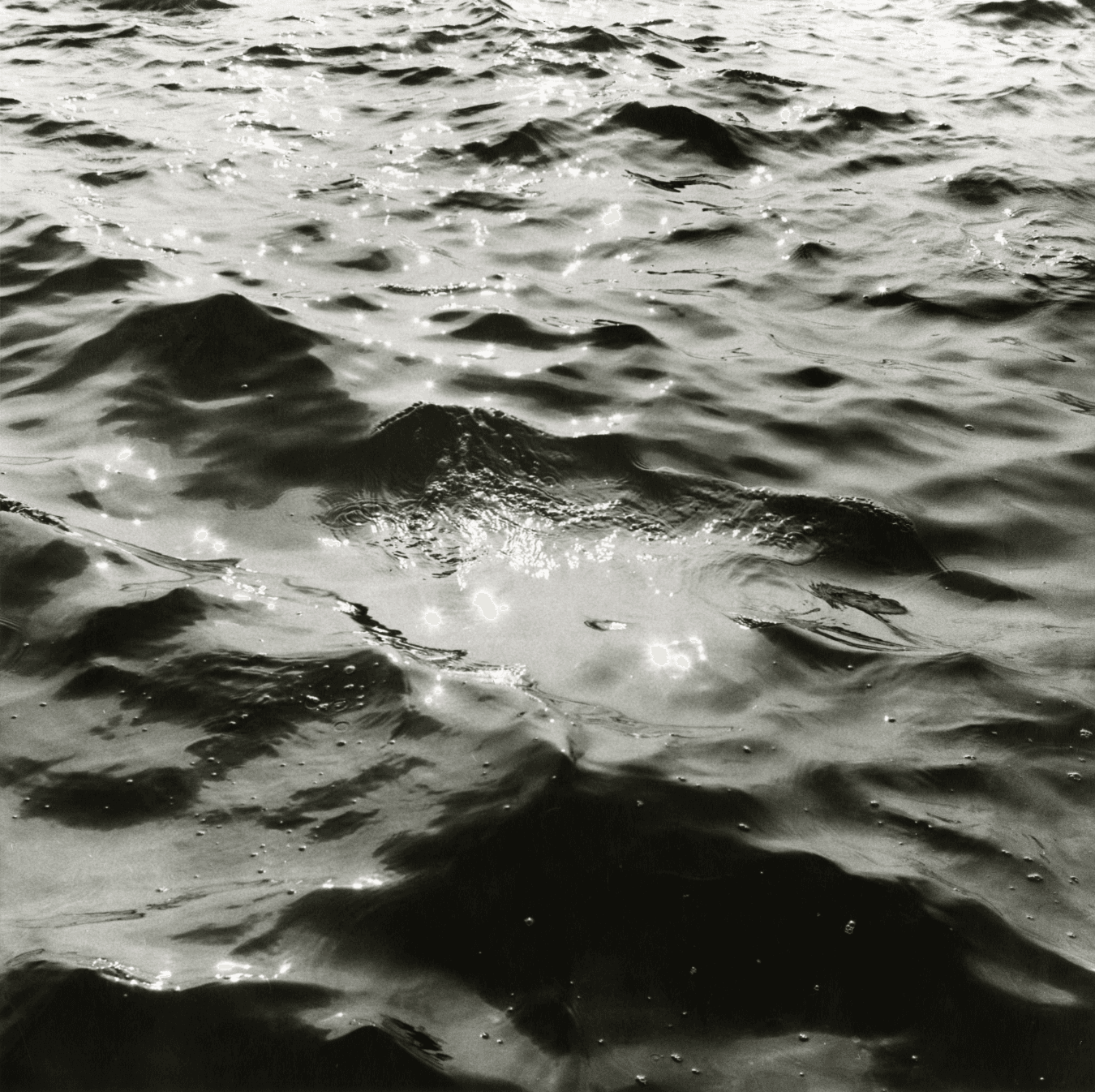
Peter Hujar, Hudson River (III), 1976
© The Peter Hujar Archive / VG Bild-Kunst, Bonn 2026
“Becoming, being, and most crucially, staying an icon is a way of living, surviving — a way of dying.”
Gently deconstructed against the reflections of Deschenes’ work, it’s hard to tell if Hujar’s images, as they say, “resonate.” Hot pics of gay people, forever, and ruins and Manhattan, and at the same time, they are burdened with traces of a contemporary nostalgia. Many want them, as my friend Sebastjan offers, to teach us something, perhaps about resilience, community, etc., but to an extent, they have always been based on negatives, loss. You may have admired Hujar’s Orgasmic Man on the bookshelf of someone you find mildly annoying, on the cover of A Little Life, one of the many cases in which mainstream middlebrow culture turns to gay love to reinvigorate sentimental notions of romance, and even more broadly, the titular life. Even though the wildly renewed interest in Hujar’s body of work is a very recent phenomenon, it’s as if his photographs have been everywhere for a long time. The longing to “have always been there” makes his entire oeuvre click into place beyond any famous individual images. Their iconic status is, in a way, undeniable, a simple fact. It would be facile, however, to mistake this iconicity for either appropriation or inclusion, for canonisation, when in reality, becoming, being, most crucially, staying an icon is a way of living, surviving, a way of dying. Just look at Candy Darling, gorgeous on her deathbed. A hospital fluorescent tube can be a stage light. She placed the rose there herself. Across Hujar’s frames, terminally cool people lay, gently stretched out, across New York hotel couches and into landscapes, at a slight remove from their everyday selves. Hujar has ever-so-slightly topped them into form, captured half-way between friendship and iconicity, between stillness and movement, their historicised biographies and a line of flight. Again, Deschenes’ precision cools these photographs, lays bare in them Hujar’s subtle affinities with his contemporaneous minimalism, which is to say, with questions of infrastructures. Take Deschenes’ Retaining, which resembles a support element used in the conversation of ruins – but in Deschenes’ case, is made of glass and itself highly breakable. Retaining supports Hujar’s structures, retains, quite literally, the care that they’re not quite aware of, precisely by being fragile and extra. “Queer history,” or whatever you want to call it, especially post-Stonewall and pre-AIDS, is often thought to be about excess, transgressions, even self-actualisation, etc. But between Hujar’s poses and Deschenes’ infrastructures, it appears as something restrained, formal, precise. You can’t, these works seem to intuit intimately, disentangle poses from their material conditions, or vice versa.
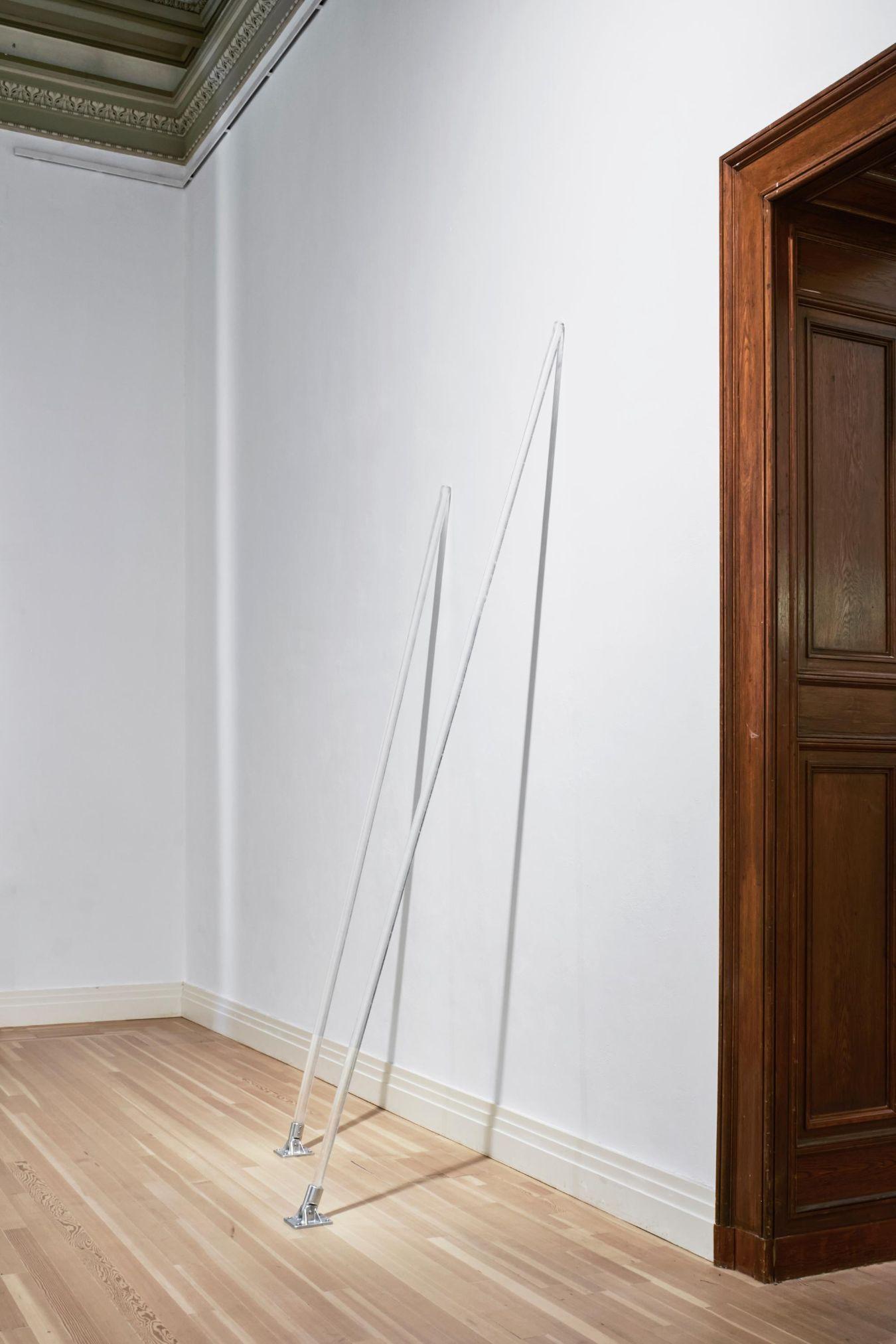
Liz Deschenes, Retaining, installation view, Gropius Bau, 2026
© Gropius Bau, photo: Luca Girardini
Does Berlin still exist? Where even the most agreeable pro-Palestinian cultural project is silently being defunded and some of the sharpest rent increases in Europe puncture neighbourhoods, where relative economic growth sustains the Germanisation that’s the long game of “reunification,” it’s become a commonplace to say that Berlin is over. Saying that Berlin is over is over. But it still hurts. Ouch. And did it ever, though, exist? There has long been an element of misunderstanding in, specifically, the 2000s anglophone and significantly gay image of Berlin as a failed city, last resort of sexual freedom, cheap apartments, artistic affordability. The city has long been more provincial and policed, and at once more diasporic, poorer and politically contested than any pre-Snax Cabaret watch party would have you think. While discussions about whether Berlin ended in 1993 or in 2014 or 2023 are silly, and while so many of the transformations have been painfully gradual, it’s perhaps most of all this gravitational force of fantasy that has suddenly and undeniably changed its tack.
When I first see it, there are a few events taking place as part of the exhibition. I spontaneously meet some friends in front of the building, some of them by accident. It’s kind of random that we’re all here, a flavour of randomness that’s rapidly evaporating in the current environment. We go inside to look for the picture of Gary Indiana, a writer who we admire and whose death still feels recent. That’s how long a life can stretch when lived bitchily, from the past that never existed into whatever threatens to be the present. The work is titled Gary Indiana Veiled, yes, like a bride, or a child playing. His face is almost pressed into a semi-transparent scarf dotted with sequins, his mouth closed in a way that indexes its capacity to open. The eyes, too. Soft undertones of erotic asphyxiation: needless to say. In his big disappointment novel Everything We Do in the Dark, written just before 9/11, Indiana writes:
“Zeitgeist is a historian’s favorite hallucination: a confidence trick, quanta leaping over the specific. ‘These people lived and died clutching statistically measured expectations to their breasts, delusions wired into their brains by lulls in the convulsions of time.’ We missed the big picture because our eyes locked on some whirling dervish in the lower left corner. All of us, except a few farthinking individuals, avatars who shift history with their bare hands, starvation protests, atom bombs, religious manias, or the raw will to power. The rest of us were caught by surprise when we woke up buried to our necks in shit. Let's assume, at least, that the big picture isn't a rectangle, a film of watered silk in a frame, or a mastermind's jump cut, but something more like an urn on a mantelpiece. Not everyone gets buried. Some burn.”
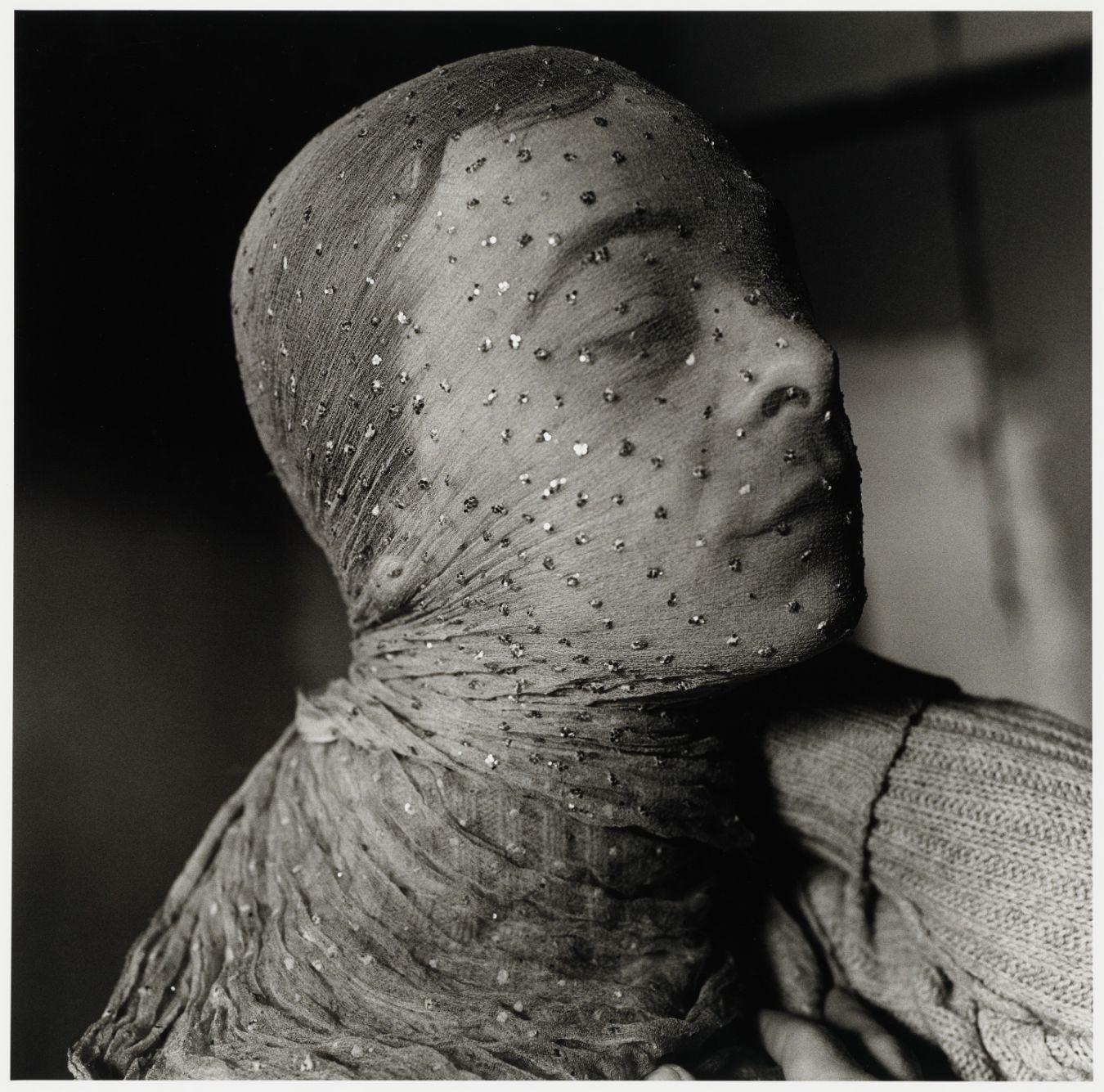
Peter Hujar, Gary Indiana Veiled, 1981
© The Peter Hujar Archive / VG Bild-Kunst, Bonn 2026
“From the standpoint of the group hang, in the pristine twilight of friendship’s idealisation, the city bristles with its own over-ness.”
As we leave, Selin Davasse is a pigeon in the stairways. The pigeon dreams of castrating a man on the street, if I remember correctly, snatching his dick. A German lady in fiercely red tights has a strong reaction to the performance, holding Selin’s pigeon-ed up hands tight in her own.
Most of us haven’t seen each other in a while. Alarming and cartoonish new symptoms have emerged, twitching eyelids, mysterious STIs that don’t mean anything, obscure sources of money, only partly imagined. K., who has minimised his upper-body wardrobe to hoodies screenprinted with trash bags, is going to leave Berlin for New York, where people have more money for gay trash. There’s a new mayor. It doesn’t have to be the end of an era. S. is going to be a world-famous and her parents text from Beirut as Israeli bombs are falling. L., whose career as an actually good art critic has recently abandoned him is training to become a psychoanalyst but he might be too bitchy for even the most indecent Lacanians. B.’s studies of Grindr-based heterosexuality in the wartimely booming oil fields of West Texas. M.’s reports of the dark room after FLINTA*, where people who are all exes and exes’ exes try to transpose the art of lesbian cruelty to cruising. These are some of the anecdotes, carefully exaggerated, thrown into relief by an ambient lack of perspective. The anecdotes are wrong because they are not disgusting enough. Tomorrow, one of us will snitch a vegan protein bar from a irrelevant hookup’s emergency stash. Defeat, a friend of a friend says, does not prove anything.
For now, for a brief moment, everyone is interesting at the group hang. I look around and individually, everyone is still embarrassing, which is to say, it’s the other way around, for a brief moment, the group hang makes everyone be interesting. From the standpoint of the group hang, in the pristine twilight of friendship’s idealisation, the city bristles with its own over-ness. It’s funny that this is what “over” looks like: Like the suicidal glossy public sculptures in the so-called “Hudson Yards,” just a few blocks from where Hujar photographed some street scenes. Over looks like the psychotically flat and dubiously funded façade of a literal city castle in Berlin. From the standpoint of the group point, as T. checks out her middle part via the front camera of his phone and Z. wants to leave, “we begin to recognise,” as literally Walter Benjamin once advised, “the monuments of the bourgeoisie as ruins even before they have crumbled.” We suspend our doom and gloom, give it form.
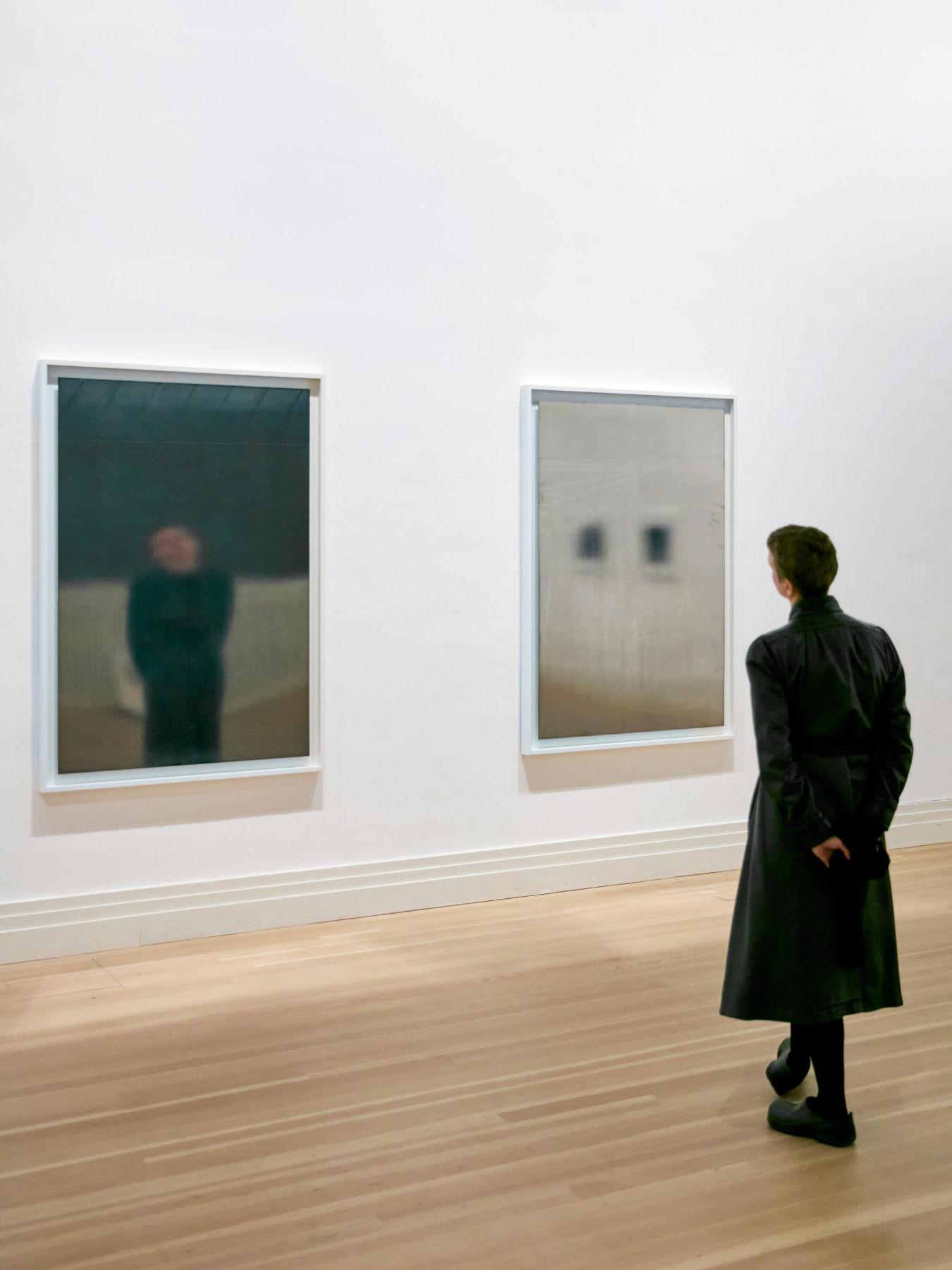
Peter Hujar / Liz Deschenes: Persistence of Vision, installation view, Gropius Bau, 2026
© Gropius Bau, photo: Luca Girardini
Maxi Wallenhorst is a writer living in Berlin. She’s a doctoral researcher at Leuphana University Lüneburg. Recent work has appeared in Berlin Review and e-flux journal.